


Between the challenges and hope, philanthropies (in plural) that resist
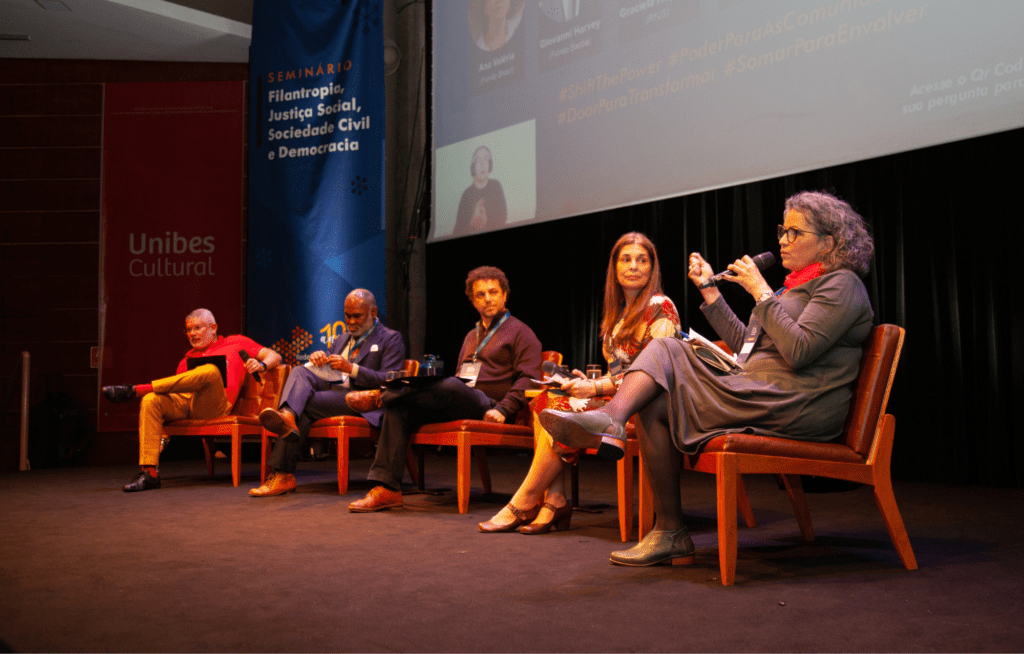
Doing advocacy work in the field of philanthropy is not an easy task. The reproduction of colonial structures, racism, misogyny, LGBTIphobia and other diverse forms of violence make philanthropy an environment that can still be very exclusionary, especially for minority groups. However, Comuá Network's 10th Anniversary Seminar “Philanthropy, Social Justice, Civil Society and Democracy”, held on the 20th and 21st of September in São Paulo, was an important reminder to all those present that philanthropy can also be a space for resistance, struggle , collaboration and, especially, hope .
Perceptions about Philanthropy

By Mariana de Assis
Philanthropy, Social Justice, Decolonial Philanthropy, Human Rights, Democracy. The 10-year Seminar of the Philanthropy Network for Social Justice – now titled Rede Comuá – immersed us in these themes and, in two days, brought together in a single environment the references of the national and international philanthropic system. I was there.
It's funny to note that when I started my professional work in the social field years ago, the notion of philanthropy was welfare, charity. The evolution in conversations, and cultural political moments, provoke welcome questions and reflections on the reframing of the concept.
Perceptions on philanthropy
Philanthropy, Social Justice, Decolonial Philanthropy, Human Rights, Democracy…
The 10th Anniversary Seminar of the Brazilian Philanthropy Network for Social Justice – now Comuá Network – immersed us in these themes and, in two days, brought together in a single environment the references of the national and international philanthropic system. I was there.
It's funny to observe that when I started my professional career in the social field years ago, the notion of philanthropy was linked to assistentialism, charity. The evolution in conversations, and the cultural political moments, provoke questions and reflections on the re-signification of the concept that are welcome.
Culture of Donation: episode of PodCast Dom Cabral interviews executive coordinator of Rede Comuá

By Camila Guedes
The newest episode of the Fundação Dom Cabral PodCast series on donation culture spoke with Graciela Hopstein, executive coordinator of Rede Comuá, and had philanthropy and the national context as its theme.
In her participation, Graciela discussed the work of Rede Comuá in the field, the current scenario of philanthropy in Brazil, the perspectives and potential of the medium.
Is the decolonization of philanthropy advancing?

The colonialist mentality has contaminated philanthropy practices in Brazil, but there are transformative ways to overcome it
By Allyne Andrade e Silva and Graciela Hopstein
Traditionally, philanthropy has been structured around an extractive colonialist logic. Coloniality of power is a term coined by Anibal Quijano to characterize the typical pattern of global domination in the modern capitalist system, whose origins date back to European colonialism at the beginning of the 16th century. Throughout the colonial process, Europe positioned itself as the central point of civilization, most advanced in the development process, not only of politics and economics, but also of humanity itself.
The metaverse of Philanthropy: building transformative realities based on social justice
By Marcelle Decote
You may have already heard or read something about the technological phenomenon of the moment: the existence of what we call the Metaverse. This is nothing more than the terminology used to indicate a type of virtual world that tries to replicate reality through digital devices. A reality shaped and controlled by a programmer, who operates through tools other possibilities for different worlds and meanings of good living.
The metaverse of philanthropy: Building transformative realities from social justice
You must have heard or read something about the technological phenomenon of the moment: the Metaverse. It is nothing more than the terminology used to indicate a type of virtual world that tries to replicate reality through digital devices. A reality shaped and controlled by a programmer, who operates through tools other possibilities of different worlds and senses of well-being.
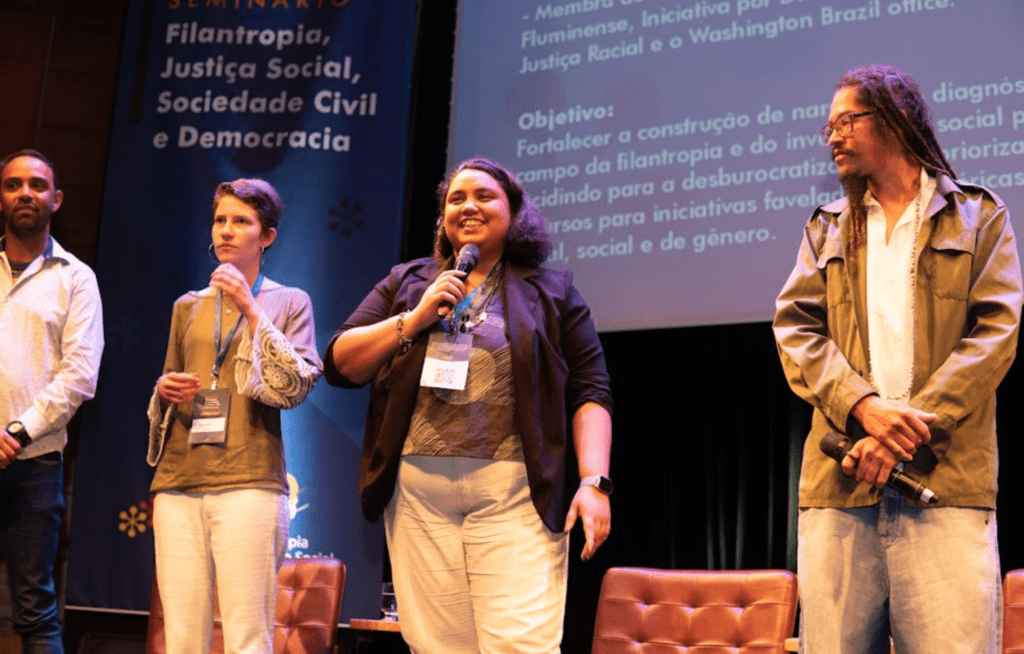
Past September, in the city of São Paulo, Brazil, the Brazilian Philanthropy Network for Social Justice – now Comuá Network, organized an international seminar that shed light on relational debates between democracy, community philanthropy, social justice and human rights, by black people, cis and trans women, by social organizations and community funds that operate significant transformations in communities. It is up to us to emphasize that in that week, our own metaverse of Social Philanthropy was created, where the reality shaped through our theory of change has at its center diversity, territory and an unbureaucratic way of doing things.
Building horizontal spaces to share knowledge
By Diane Pereira Sousa
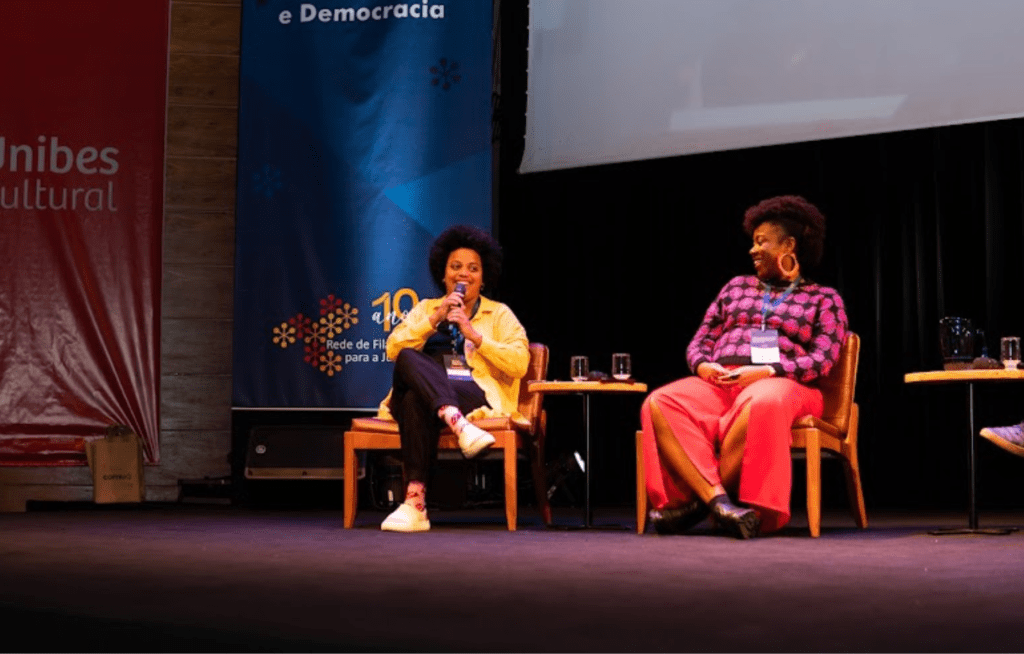
The title of this text is the first definition of Rede Comuá under my eyes. There are many ways to choose to define yourself as a network, but I will stick with the one that connects and expands. This text, which follows in a horizontal line, intends to talk to you about how knowledge is constructed based on decolonial community philanthropy. We are not designing recipes, in fact what we aim to do is build spaces with possibilities.
There are many ways to do philanthropy, few people recognize this. Here is our first frontier. When I refer to people, I am recognizing the existence of a system, mode, objective qualification about what philanthropy means for those who recognize it and not exactly for those who do it.
Building horizontal spaces to share knowledge
The title of this text is the first definition of the Comuá Network in my view. There are many ways to choose whether to define yourself as a network, but I will stick with the one that connects and extends. This text, that follows a horizontal line, intends to talk to you about how knowledge is constructed from a decolonial community philanthropy. We are not designing recipes, in fact what we aim is to build spaces with possibilities.
There are many ways to do philanthropy, and few people recognize this. Here is our first frontier. When I refer to people, I am aware of the existence of a system, an approach, an objective qualification about what philanthropy means for those who recognize it and not exactly for those who do it.
Guajajara indigenous people take part in environmental and territorial management actions in Maranhão
By Andreza Andrade
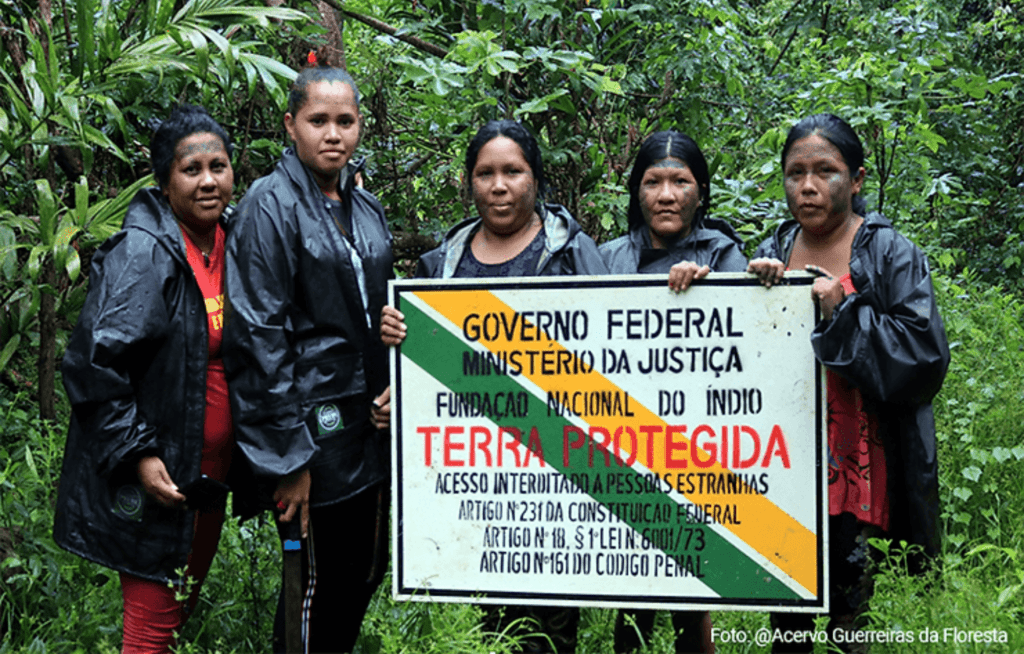
Guided by sensitivity, solidarity and empathy, Guajajara indigenous women from the Caru Indigenous Land, located in the west of the State of Maranhão, carry out environmental and territorial management actions on their ancestral lands. These women form the Guerreiras da Floresta collective, which since 2014 has supported and promoted territorial protection actions together with the Guardians of the Forest, in defense of indigenous territories and cultures.