Fundo Casa Socioambiental recebe doação de Mackenzie Scott pela segunda vez
Em entrevista à Rede Comuá, a diretora-executiva do Fundo Casa Socioambiental destacou a importância dessa doação em um contexto onde a organização completou 20 anos

Em entrevista à Rede Comuá, a diretora-executiva do Fundo Casa Socioambiental destacou a importância dessa doação em um contexto onde a organização completou 20 anos

Entre riscos crescentes e limitações das políticas públicas, a filantropia se apresenta como ferramenta estratégica para fortalecer democracia e resiliência territorial.

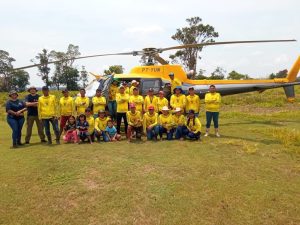
Apoio financeiro é essencial para fortalecer as comunidades indígenas na proteção territorial e no enfrentamento aos incêndios florestais na Amazônia

Um dos maiores desafios da sociedade civil brasileira é superar a escassez de recursos para apoio e expansão de suas atividades. A falta de recursos está atrelada a uma cultura de doação ainda pouco consolidada, o que, por sua vez, decorre de fatores como: limitações do marco legal e falta de incentivos fiscais para doações; desconhecimento sobre a relevância do trabalho de organizações da sociedade civil; e falta de confiança dos doadores.

Não é novidade que o Fundo Casa já tenha apoiado projetos das comunidades que contenham componentes de comunicação em suas ações e atividades. Mas é a primeira vez que uma chamada específica temática é totalmente focada para Comunicação Comunitária e Popular com a interface dos direitos humanos em assuntos ambientais. E como é da essência do Fundo Casa, essa chamada é resultado de um rico processo de escuta. Para contar um pouco dessa história, vamos resgatar alguns pontos interessantes.

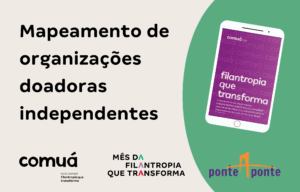
According to a mapping of independent donor organizations carried out by the Comuá Network in association with the pontAponte consultancy service, there are currently 31 organizations in Brazil supporting initiatives in the field of socio-environmental justice

Traditional, indigenous, quilombola, riverside communities, communities on the outskirts of large Brazilian cities and political minorities in general are the social groups most affected by climate change.

Rede Comuá, in partnership with pontAponte, launched, on September 5th, the publication “Philanthropy that transforms: mapping of independent donor organizations for civil society in the areas of socio-environmental justice and community development in Brazil”.
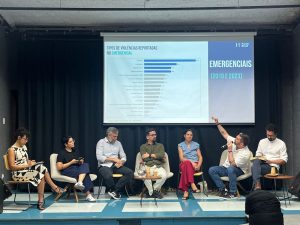
The online event was attended by 165 people, and had as guests Cássio Aoqui, from PonteAponte; Cristina Orpheo, from the Casa Socioambiental Fund; Gelson Henrique, from the PIPA Initiative; and Ese Emerhi, from the Global Fund for Community Foundations. The mediation was carried out by Graciela Hopstein, executive director of Rede Comuá.

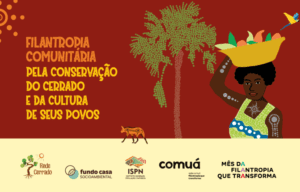
With the aim of debating and presenting practical examples of philanthropy for socio-environmental justice in the context of preserving the Cerrado, Rede Comuá, the Instituto Sociedade, População e Natureza (ISPN), Fundo Casa Socioambiental and Rede Cerrado will promote, on the 15th , the “Dialogue on the Importance of Community Philanthropy in the Conservation of the Cerrado and the Culture of Its Peoples”, during the X Meeting and Fair of the Peoples of the Cerrado, in Brasília.

Communication is a fundamental human right. The movement for its recognition as such took place throughout the 20th century, as the flow of information began to become greater and greater. International organizations such as Unesco, with the so-called MacBride Report (also known as One world and many voices) began to recognize this right, which means guaranteeing that people should be able and able to express themselves freely, produce and circulate information.
In guaranteeing this right, there are economic, social and political issues that impose inequality in this place as well, limiting the conditions for all, all and all, to be producers and disseminators of information by concentrating the means of communication and economic resources.