


Network members launch Territorial Funds Alliance
Initiative aims to strengthen communities and territories
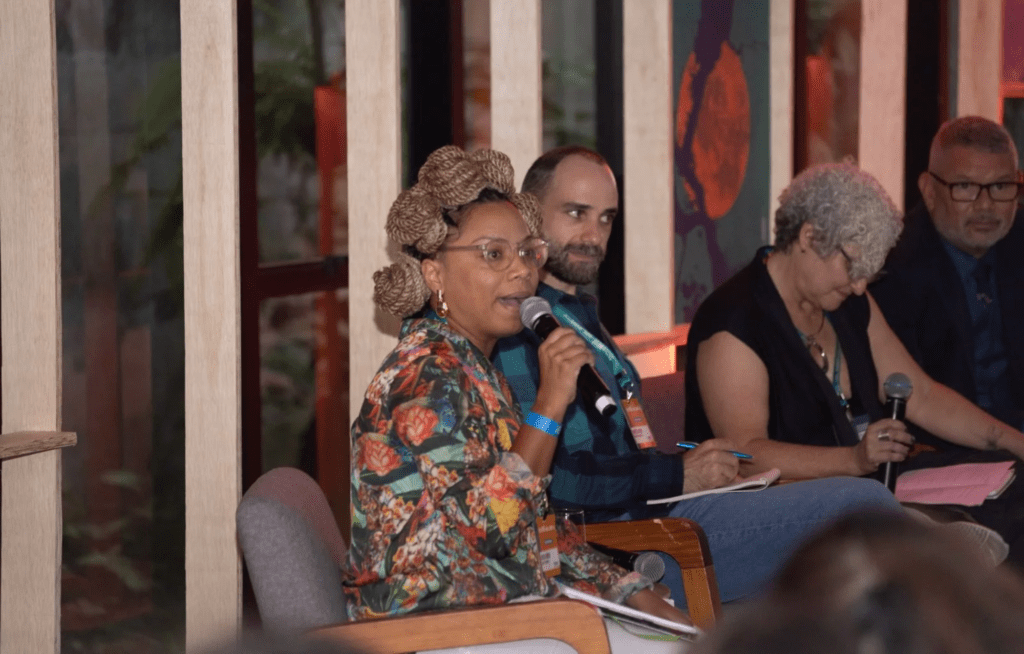
De 12 a 14 de abril, a Rede Comuá participou do 12º Congresso GIFE (Grupos, Institutos, Fundações e Empresas), com a mesa “Filantropia Comunitária: mobilização de atores diversos para a mobilização”. Na ocasião, Larissa Amorim, coordenadora executiva da Casa Fluminense, que participou como uma das palestrantes, anunciou a constituição da Aliança Territorial.
Created in the context of Rede Comuá from the articulation of seven member organizations: Tabôa – community strengthening, FunBEA (Brazilian Environmental Education Fund), ICOM (Great Florianópolis Community Institute), Baixada Maranhense Community Institute, Redes da Maré, Instituto Procomum and Casa Fluminens, the initiative aims to promote articulation and exchange of experiences between territorial-based organizations (community funds and community foundations), seeking to develop joint strategies and reflect on the challenges of mobilizing resources for the institutions involved.
Rede Comuá advances research on community philanthropy and Private Social Investment
By Monica C. Ribeiro
How can ISP (Private Social Investment) strengthen community philanthropy?
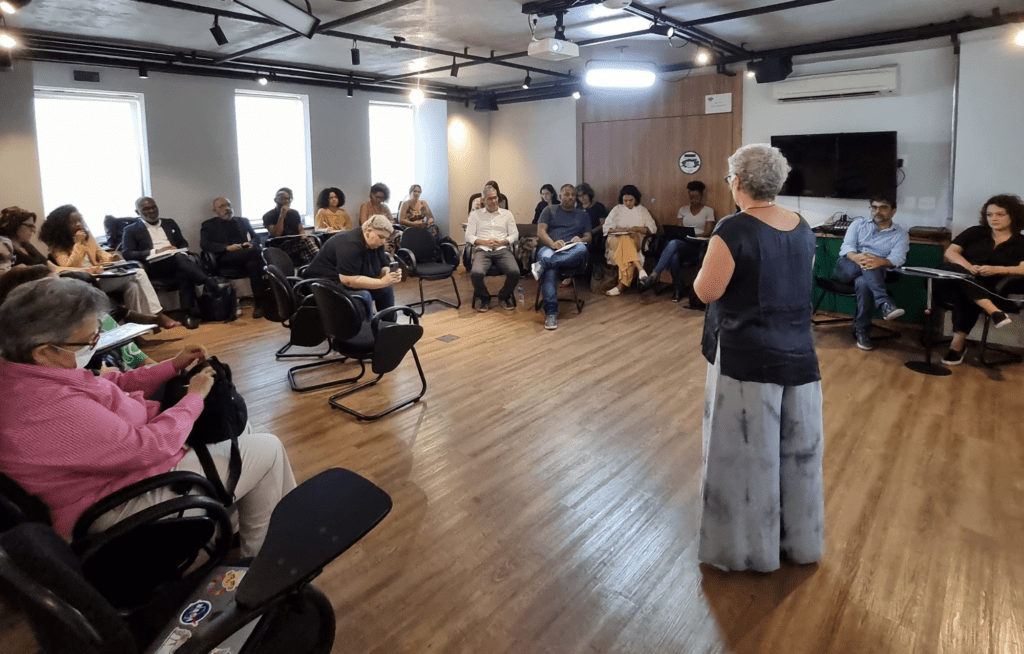
Based on this question, Rede Comuá, in partnership with GIFE (Group of Institutes, Foundations and Companies) has been developing an initiative that aims to promote the community philanthropy agenda in the field of private social investment.
The starting point was the elaboration of a diagnosis, which included the participation of social investors and community and socio-environmental justice funds, which aimed to map approaches and practices of community philanthropy that can serve as a basis for building and strengthening this schedule.
Decolonizing Evaluation: 4 conclusions from a panel of donors
Por Ben Bestor
In recent years, the chorus of voices calling for the decolonization of aid has been growing, demanding a reevaluation of the way programs are designed and even the way they are delivered. This evaluation – a process that consists of critically and systematically analyzing the design, implementation, improvement or results of a program – is an integral part of a broader dialogue about decolonization.
When it comes to evaluating a project or program, it is worth reflecting on a series of questions. What constitutes “effectiveness”, how is it measured, and who determines it? Whose values, priorities and worldviews shape the assessment? Historically, it has always been donors and international non-governmental organizations (INGOs) – in other words, external parties – who determined what would be evaluated, when it would be evaluated, by whom and based on what methodologies, accepting few relevant contributions from the people concerned. be achieved by the programs in question. This needs to change. But what will this change look like?
Decolonizing evaluation: 4 takeaways from a donor panel
Over the past few years, a growing chorus of voices calling for the decolonization of aid has emerged, necessitating a reevaluation of the way programs are designed to the way they are delivered. Evaluation—the process of critically and systematically assessing the design, implementation, improvement, or outcomes of a program—is part and parcel of this broader decolonization conversation.
When it comes to evaluating a project or program, it is worth reflecting on several questions. What constitutes “effectiveness,” how is that determined, and according to whom? Whose values, priorities, and worldviews are shaping the evaluation?
Five things we learned from feminists about giving

By Renata Saavedra and Vanessa Lucena
We were lucky enough to get to know the world of philanthropy from a very special point of view: the women's fund ecosystem. Women's funds are organizations that mobilize and donate resources to groups of women, girls and trans people around the world, providing them with financial and technical resources and strengthening networks to realize their vision of social justice. More than 40 of them come together in Prospera, a powerful global network.
Institutional strengthening in boosting community philanthropy in Brazil

By Bianca Limonge Avancin
In Brazil, from the 1940s onwards, NGOs (Non-Governmental Organizations) were known for movements formed by Churches (Catholic and Protestant) that prioritized the structuring of solidarity and humanitarian actions throughout the territory. Over the years, this conception of what an NGO would be gained different perspectives, including popular education movements, combating the military dictatorship and countercultural movements.
Cerrado could lose a third of its water, study shows

Deforestation for monoculture and pasture is mainly responsible for the 34% decrease in river flow by 2050
In the Cerrado, 93% of the basins may have a reduction in water availability, this is what the study The heavy impact of deforestation and climate change on the streamflows of the Brazilian Cerrado biome and a worrying future, supported by ISPN, points out. According to research, the biome could lose 34% of its water flow over the next 28 years. The study being reviewed by the scientific journal Sustainability concluded that deforestation is the main cause of this decrease, responsible for 56% of the impact. 23,653 m³/s could be lost by 2050, in the rivers analyzed in the study alone, this loss is equivalent to the flow of eight Nile rivers.
Community and independent philanthropy is present in several regions of Brazil
Mapping identifies independent organizations working with donations to civil society groups and movements that focus on the fields of social justice and community development in the country
By Mônica C. Ribeiro
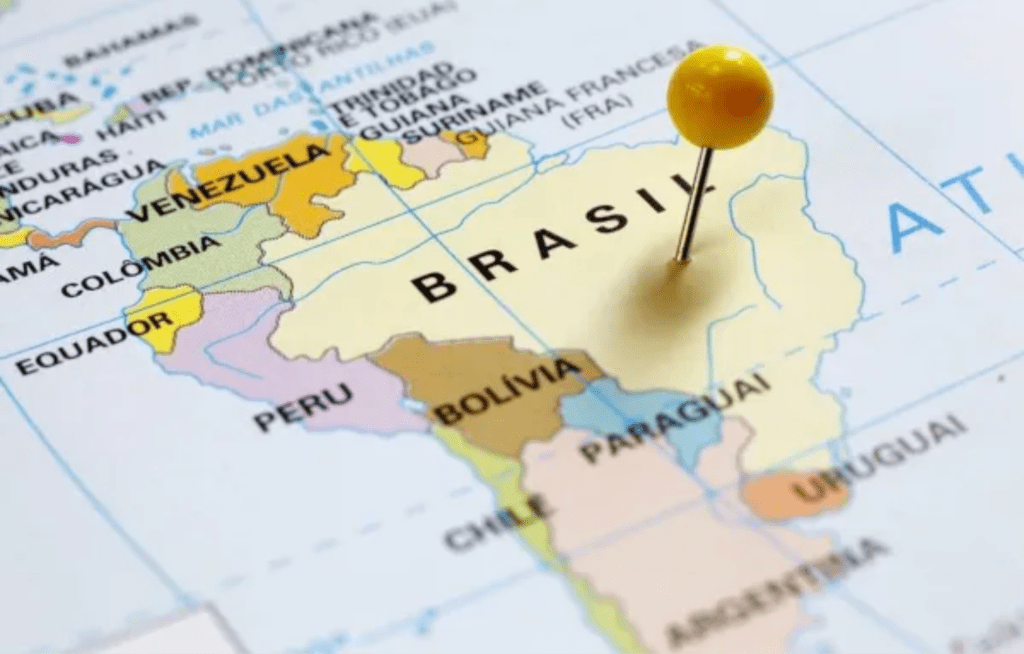
Produced by the Comuá Network in association with PonteAponte, the mapping of thematic, community funds and independent community foundations working with donations to civil society organizations, in the fields of social justice and community development, identified 31 of them in different regions, with different priorities agendas.
Independent and community philanthropy is present in several regions of the country
Mapping identifies independent organizations that work with donations to civil society groups and movements that work in the areas of social justice and community development in the country
By Monica C. Ribeiro
Carried out by Rede Comuá in partnership with PonteAponte, the mapping of thematic, community funds and independent community foundations that work with donations to civil society organizations in the areas of social justice and community development identified 31 of them in different regions and priority agendas.
Alliance between Funds: for another collaborative philanthropy under construction in Brazil
By Allyne Andrade e Silva, Angélica Basthi, Cristina Orpheo and Fernanda Lopes
Although collaboration is an old practice among philanthropic organizations, the idea of “collaborative philanthropy” is relatively new. In Brazil, this is a concept still under construction. Here, he has been encouraging the creation of new arrangements in the field of philanthropy for social justice.
However, none of these initiatives have experienced bold and innovative action as has been practiced by the Baobá Fund for Racial Equity, the Brazilian Human Rights Fund and the Casa Socioambiental Fund within the scope of the Alliance between Funds, which emerged in 2021.