By Claudia Cruz and Fabbi Silva
March 11, 2020 became known as a global milestone for the pandemic, when many states began to adopt the Ordinance 356 of the Ministry of Health which regulated measures to combat the health emergency due to the coronavirus. In the state of Rio de Janeiro, the then governor, Wilson Witzel, published a decree, on March 16, which instituted quarantine/social isolation with more restrictive circulation measures. A few days later, on March 19, the state recorded the first death from COVID-19, a 63-year-old black woman and domestic worker. And that is why, this Thursday, as we complete the first year of the global milestone, in the middle of March of struggles and for Marielle Franco, we reflect on the impacts that the pandemic has had on the lives of women in Rio de Janeiro. We are the majority in the Metropolitan Region, where we total 52,86% of inhabitants, and we were the first to die from COVID-19.
In addition to this, which is the most lethal consequence of the current pandemic that has shaken the world, women remain historically responsible for care at different levels in this crisis, whether on the front line of family care, in other people's homes, in health teams in the face of COVID-19 or leading the humanitarian support system that made it possible for food and information to reach the most vulnerable groups in our neighborhoods and favelas on the metropolitan outskirts. In this sense, a year later we see the side effects of this overload of work and care with the reduction in the participation of these women in the job market, which directly impacts the livelihood of their families, and the damage to the physical and mental health of those who were essential in care relationship.

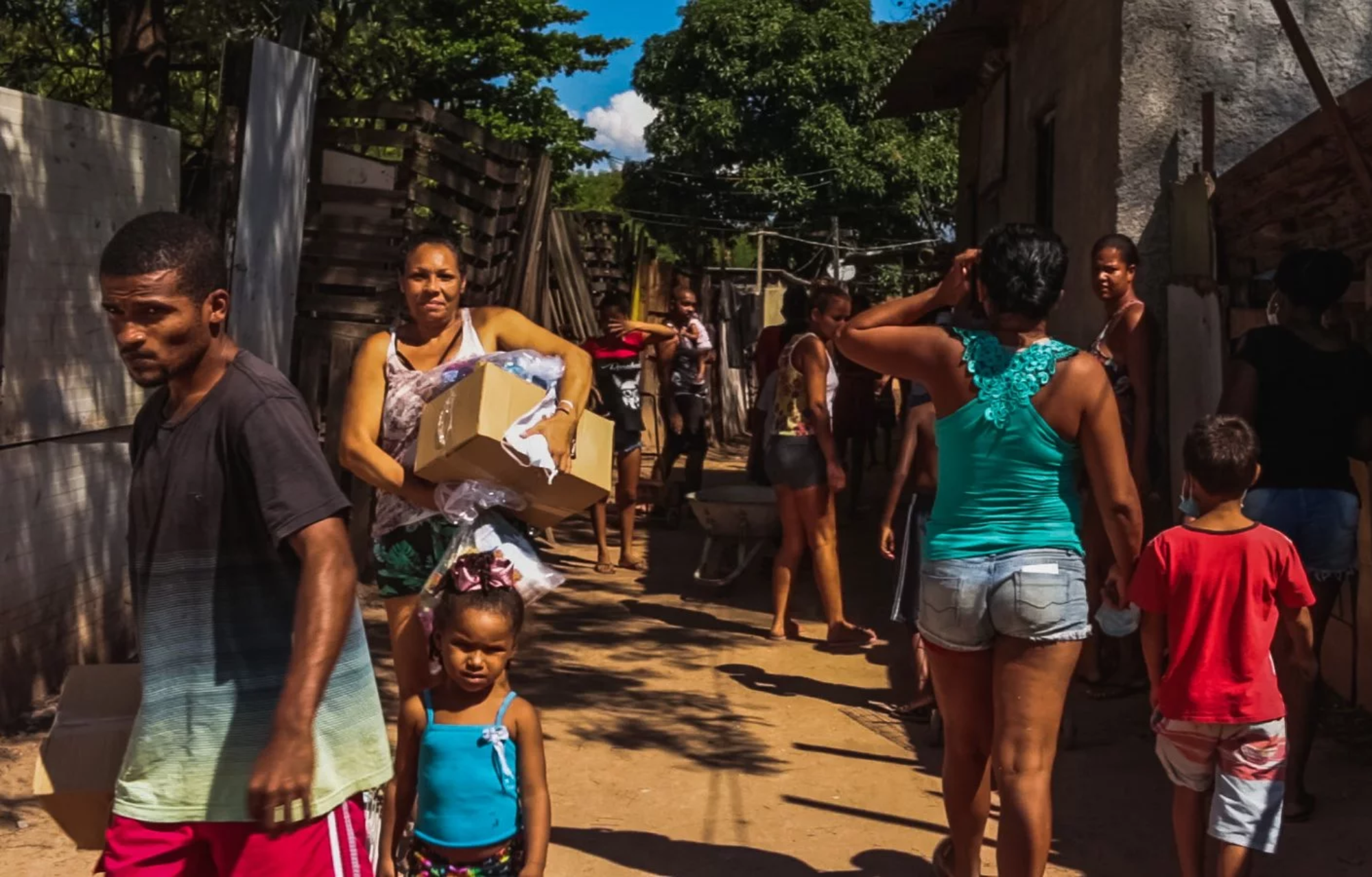
In community networks to combat hunger, collect cleaning kits, PPE and welcome other women and families, it is black women who are leading survival and innovation strategies in the midst of chaos, but who are also demanding immediate return emergency aid and strengthening of structural public policies such as the Unified Health System – SUS, the Unified Social Assistance System – SUAS, the universalization of education and the promotion of agroecological production and food security. And it is at this moment that we raise the most important alert that this text seeks to bring, because if these black and peripheral women are leading community initiatives to combat COVID-19 and the most worrying statistics on the job market and unemployment, this account will never close and the resultant will continue to multiply inequalities.
Added to this worrying reality are two other factors that directly influence the lives of these women, their families and communities, which are the immunization plan and the emergency basic income. Regarding the National Immunization Program, execution is affected by a lack of planning and an effort to create harmful misinformation about the virus, vaccines and even the use of masks. Of the six vaccines approved in studies for inoculation around the world, Brazil requested approval for only two from ANVISA. The direct consequence is a delayed immunization program, whether due to diplomatic, political relations or simple mismanagement, which immunized only 4,26% of the population by March 10th. The longer it takes for vaccines to arrive in states and municipalities, the greater the risk for this population of virus variants, an increase in cases, overload of the SUS, overcrowding of beds and a deepening of the economic crisis.
An initiative titled “vacinometer” monitors the progress of the Vaccination Program in the country, but the state of Rio has not updated the data on this platform, presenting only data from the capital, without exposing the immunization situation in the Metropolitan Region of Rio de Janeiro. The acting governor, Cláudio Castro, vetoed a bill that authorized the state to purchase any vaccines against COVID-19 authorized by ANVISA, regardless of authorization from the National Immunization Program, claiming that this proposal would increase the state's expenses. Furthermore, RJ also did not sign the National Pact in Defense of Life and Health proposed by the National Forum of Governors, even approaching 34 thousand deaths from COVID-19. In Baixada Fluminense, in the municipality of Duque de Caxias, the mayor's recent announcement about the vaccination of elderly people over 60 years old, provoked a disorderly search for the medicine, since the number of doses available was much lower than the population of elderly people over 60 years old.
Meanwhile, hunger and discouragement among the most vulnerable population on the outskirts of the metropolis are growing. According to an analysis by the Legislative Assembly's Tax Office, based on data from CAGED, between 2014 and 2020, Rio de Janeiro was the state that lost the most jobs in the last six years, with 16% of the population of Rio de Janeiro unemployed. In response, this week, Alerj approved the PEC that authorizes resources via Anti-Poverty and Environmental Conservation funds to cover state emergency aid for the Supera Rio Program (Law 9,191/21) with a value of 200 to 300 reais. In the National Congress, the Basic Income and Emergency Aid campaigns of 600 reais until the end of the pandemic continue to demand minimum subsistence conditions for Brazilian families, in parallel with the increase in the basic food basket, gas and transport fares.
With this general scenario, we need to demand a more efficient Immunization Program with a greater volume of vaccine purchases, expansion of testing and treatment for everyone, and a plan to combat COVID-19 in favelas and outskirts with a focus on containing the spread. contagion and expand access to health and social assistance policies. According to Rio de Janeiro COVID-19 Unifying Panel, Rio’s favelas have more deaths from COVID-19 than 162 countries. In the economic aspect, it is urgently necessary to guarantee emergency aid of 600 reais until the end of the pandemic for low-income families and the double quota for single mothers. In the capital of Rio de Janeiro, in February this year, families that receive a minimum wage have already committed 60% of their income to a basic food basket, paying for the third most expensive food basket in the country, according to research by DIEESE. So it is #VaccineForAll It is #600until the end of the pandemic already.
Fabbi Silva is a pedagogue, creator of the NGO Apadrinhe Um Sorriso and mobilization coordinator for Casa Fluminense.
Originally published in: https://casafluminense.org.br/1-ano-de-pandemia-e-o-impacto-sobre-a-vida-das-mulheres/