By Bianca L Avancini, Larissa Boing, Roberto Vilela, Semíramis Biasoli, Simone Amorim, Willian Narzetti
Among the various philanthropy practices existing in the Brazilian scenario, collaborative architectures have been strengthened as a path for the development of territories, from a perspective that assumes the construction of socio-environmental justice as its horizon. Forged from the praxis of various social actors, especially organizations and collectives that make up organized civil society, this is a field under construction. For this reason, it is important to deepen reflections on this way of practicing and thinking about philanthropy, having the dimension of the territory as its structuring axis.

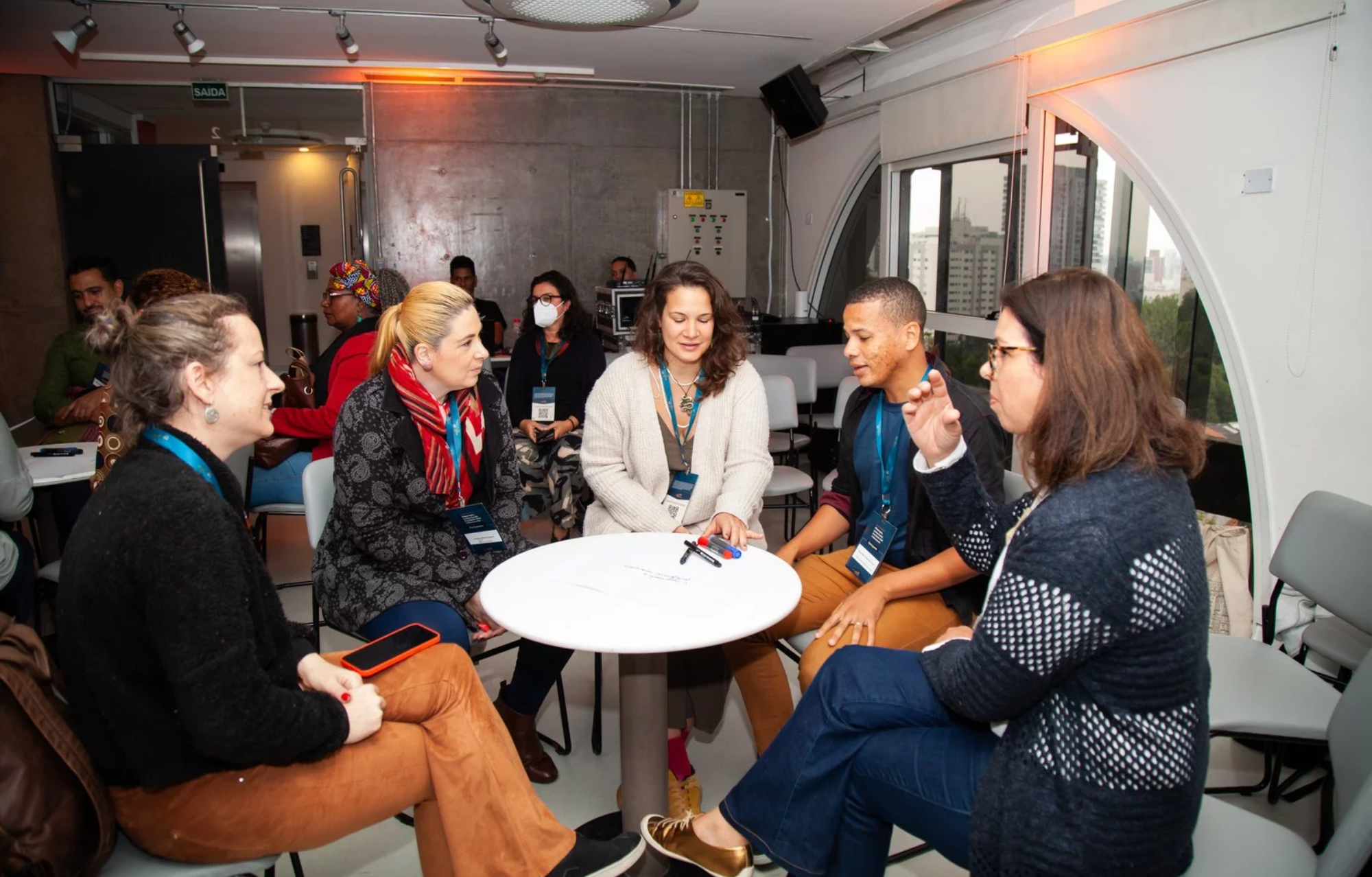
Assuming the experience as a field for building empirical, technical and political knowledge, three strategic dimensions for reflection were identified, presented in a seminar and discussed with the workshop audience, through the participatory methodology known as world café. Some of the main contributions, reflections and lessons learned are recorded in this text.

Production and dissemination of knowledge: the ICOM experience
For ICOM, in-depth knowledge of the territory is a condition for defining community development strategies. Thus, for 16 years, ICOM has been carrying out participatory social diagnoses in the Greater Florianópolis region, aiming to identify, together with the community, priority areas and challenges for improving the local quality of life.
The methodology of these diagnoses, called Vital Signs, is inspired by the Vital Signs project, carried out by community foundations in Canada. It proposes a contextualized analysis, based on indicators available in research institute databases, involving the community and experts, through participatory workshops, in the discussion and contextualization of the data collected. By bringing together actors involved daily with the proposed themes, the process of preparing diagnoses also contributes to strengthening action networks of public interest.
Furthermore, simple language is used, which is easy to understand and visually attractive.
With this, Vital Signs articulate information that was previously disconnected, in contextualized analyzes that facilitate understanding, guide the local press, support discussions and collaboration between public policy makers, academia and civil society organizations. At ICOM, the results of Vital Signs drive the design of specific projects and notices to meet the identified challenges, in addition to resource mobilization strategies to make them viable.
Resource mobilization: the FunBEA experience
FunBEA's contribution to strengthening the field of philanthropy is anchored in the principles of critical Environmental Education, which argues that being on the ground in the territory alongside leaders and collectives is what enables the sustainability of actions. It is also the field that believes that individuals are strengthened with emancipatory training processes capable of creating an environment for the construction of knowledge, understanding of the political situation and collective action, contributing to the empowerment and emancipation of the population to seek what is necessary for a dignified life and an ecologically balanced environment.

These principles also guide actions to mobilize local financial resources, such as the 2022 donation campaign, presented at the thematic table. The campaign is made up of four strategies: 1a) Collaborative arrangement in the territory – Monthly meetings with members of the supported collectives with a view to training them, based on FunBEA's experience in the subject of resource mobilization, and in the exercise of praxis during the campaign ; 2a) Construction of communication materials focused on the financier. In this case, there was encouragement to delimit and/or strengthen the identity of each collective, as well as respect and dialogue about political positions; 3a) Mapping and prospecting with the definition of a specific territorial section, the North Coast of São Paulo, which is one of the most important preserved Atlantic Forest strips in the country, in addition to joint construction with collectives and the learning community (ICOM and Tabôa) of prospecting tactics; 4a) Donation based on trust. In other words, priorities are defined together, and the collectives have autonomy in self-management and use of the resource. In addition to more democratic accountability and educator.
Community engagement and protagonism: the Tabôa experience
At Tabôa, the design and management of collaborative architectures for collective action start from the recognition of the territory as a power and assume trust as a principle. Nessa perspective, collaborative philanthropy with a territorial focus is based on the premise that communities must be protagonists of changes, defining their priority agendas and participating in decisions about local resources.
Since 2014, Tabôa has worked to strengthen civil society in Serra Grande and surrounding areas, in the south of Bahia, by democratizing access to financial resources, knowledge and encouraging cooperation. One of the strategies used has been the strengthening of instances of collective participation, such as the Community Committee, through which community representations participated in the decision on which initiatives should receive support in project calls, thus evaluating priorities for strengthening of the territory.
Another strategy that is underway is the structuring of a community development fund, based on promoting the culture of donation – which is already a community practice – to mobilize resources with a focus on strengthening local initiatives. What these and other experiences show us is that collaborative philanthropy must contribute to strengthening the autonomy of leaders, associations and other community-based organizations and their engagement in building collective responses to public problems.

An agenda under construction (and in dispute)
In the dialogue promoted with the participants of the thematic table, some points emerged as important for strengthening collaborative philanthropy with a focus on building socio-environmental justice in the territories. Among these, we can highlight the deepening of community listening processes, the strengthening of more accessible and pedagogical communication, the decentralization of fundraising and the expansion of networking.
Given the diversity of ways of thinking and doing philanthropy, it is important to reaffirm principles, values and strategies that shape collaborative practices based on an emancipatory perspective of the territory. It is essential, in this sense, to strengthen spaces for connection and dialogue between actors in this field, such as the learning community mentioned in this article, so that we can collectively advance in the construction of a practice that, increasingly, amplifies the voices of the territory, based on the recognition that people, collectives and local organizations are subjects of their own stories.
Larissa Boing: Project and Social Investment Fund Manager at ICOM. Master in Regional Development and Environment from Santa Cruz State University (UESC/BA), specialist in Group Dynamics, has been managing programs aimed at reducing social inequalities since 2008.
Roberto Vilela: Executive Director of Tabôa Fortalecimento Comunitário. Graduated in Business Administration and master in Public Administration and Government from EAESP-FGV, he is a specialist in microcredit and microfinance. He worked as a consultant for municipal governments, OSCIPs and private banks for the creation and development of organizations and programs.
Semiramis Biasoli: General Secretary of FunBEA. PhD in Sciences, with an emphasis on Public Environmental Education Policies from PPGI Applied Ecology from ESALQ-USP (2015), graduated in Legal Sciences from PUCCAMP (1993), postgraduate degree in Environmental Management from UNICAMP (2003).
Simone Amorim: Communications Manager at Tabôa Fortalecimento Comunitário. Master in Social Development and Management and a degree in Social Communication, both from UFBA, works in the field of guaranteeing rights and strengthening civil society, with an emphasis on social management, strategic communication, participatory and learning processes, advocacy.
William Narzetti: Executive Manager of ICOM. Doctor and Master in Administration from ESAG/UDESC. Postgraduate in Project Management. Economist from UFSC. More than 15 years of experience in community development, managing projects and integrating directors of civil society organizations in Brazil and Guinea-Bissau.