By Diane Pereira Sousa
The hands of local development are female. I begin this text with this statement, I use the Production Center of the Itamatatiua community as a basis.
I invite you to reflect on how community development is built. We will remove our gaze from the way we interact in large cities, from fast cars, from the lights that open and close, from brainstorms, from the search for improving the future, and we will place it in a different place, where our bodies, hours, structures do not they tend to be there frequently. And by being I mean the concrete action of experiencing. We go directly to Itamatatiua.
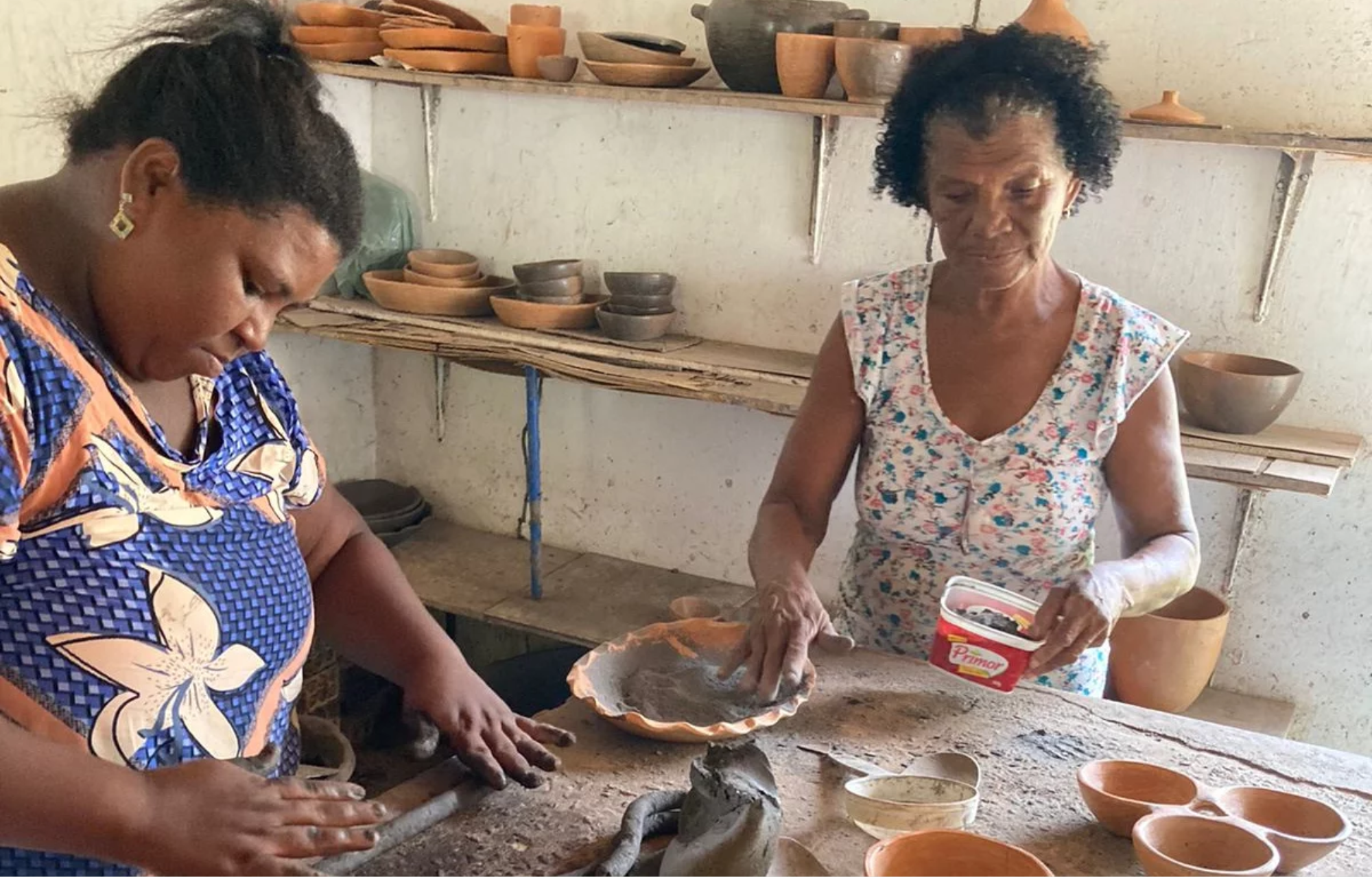
This community located in the north of the State of Maranhão is the place where ceramics are produced by a group of black women. This ancestral and economic activity has been going on for 200 years. Here is our first piece of information, the production center is therefore a business, 200 years marks the long-term planning of a process of existence, but not only that, it is also a concrete demonstration of how sustainability is built through participatory processes .

Dona Helo, received the clay from her mother's hands, the inheritance is deeper, she received the beginning, the middle and the beginning, exactly as Nego Bispo tells us. Dona Helo's daughter received the opportunity.
Here community philanthropy happens in the act. Social dynamics determine that the more I participate in the collective, the more likely I am for the collective to increase. Let's get to the main point of this text, Dona Helo gets together with Mariusca and Joana, they walk to the production center to start work, there is no need for them all to be there, but it is exactly the fact that they are together that changes the ground of the community. Each woman who is part of the production center finances two opportunities, each person who receives the opportunity has in their hands the chance to raise the level of development of the community. The barrier to survival was outdated, Itamatatiua builds its history improving now.
The community is circular, guided by a logic of solidarity that only women can establish. The fuel for transforming reality is establishing that when someone achieves growth they are not just changing themselves, but the entire structure they touch. That's why opportunities are investments.
The cars around here are people who travel in partnership, the signals are always open, because those born into scarcity have always needed to create brainstorms.
Production by the Itamatatiua community – Photo: Erika Ferreira

Women at the Itamatatiua production center – Photo: Erika Ferreira
There is potential on the community floor and to access them it is necessary in this specific case to go through some doors. We can start with the first: recognizing how women's hands create structuring systems so that that specific world continues to function.
Finally, to return them to the great center, we learn on a daily basis that the most important thing in terms of action is to be a bridge and help people in their personal and collective journeys. When they cross, we also pass with them.
Diane Pereira Sousa is from Maranhão from Baixada Maranhense. Teacher. Master in Human Rights, Interculturality and Development. Fellow Ashoka. President of the Baixada Community Foundation. Managing Partner of the Training Institute. He studies and researches everyday life, models of alternative education and youth. One of his specialties in national and international events is poetic bridges (mediations) articulating dreams and reality.
He coordinated the book “Can you hear my Voice?”. He wrote and coordinated the booklet “Human Rights and Student Protagonism” by Flacso. She is co-author of the book “About Our Grandmothers – memory, resistance and ancestry”. He wrote and coordinated the Educational Sports manuals for citizenship and social development. He wrote and coordinated the Futebol 3 systematization for children. He wrote and coordinated the book Futebol 3 – History of the use of this methodology in Brazil.
Cover Image: Erika Ferreira