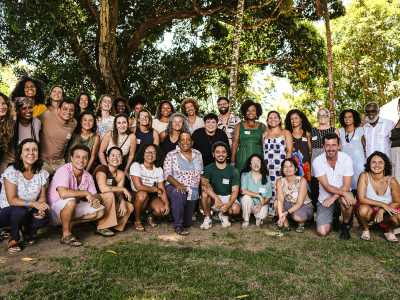
COP 27 (UN Climate Conference) mobilized funds from Rede Comuá, which were in Egypt, where the meeting took place, promoting connections, participating in debates and networking around socio-environmental justice and combating climate racism.
The Conference took place in November, from the 6th to the 18th of November, and had broad participation from Brazilian civil society, especially through the Brazil Climate Action Hub, a pavilion present at the climate COPs since 2019 created by iCS (Instituto Clima e Sociedade), together with IPAM (Amazon Environmental Research Institute) and Instituto ClimaInfo.
The space was created to give visibility to Brazilian climate action at COP 25, held in Madrid, and became a reference for Brazil in the following Conferences - especially due to the Brazilian government's setbacks in recent years in the environmental and climate area -, and has demonstrated the power and action of civil society.
The outcome of this year's Conference should be celebrated with a step towards socio-environmental justice, with the creation of a loss and damage fund to compensate countries and communities that suffer most severely from the effects of climate change, despite being those that have contributed least to for it to get worse.
With this, the agenda of adaptation to the extreme effects brought by the climate agenda, such as floods, landslides and intense rains, in addition to migrations and productive losses for family farming, comes into play.
Mitigation is fundamental to reducing greenhouse gas emissions, but it must be accompanied by concrete actions that promote socio-environmental justice, otherwise we run the risk of further worsening social inequalities. Social justice philanthropy has much to contribute in this regard. The big challenge is to make sure that resources effectively reach those who need them.
Civil society and social justice philanthropy in force at COP
Ana Toni, from iCS, highlights that the Brazil Climate Action Hub was extremely important in the last Climate COPs:
“Brazilian society demonstrated that it did not feel represented by the Brazilian government on the climate issue, and civil society organizations were true diplomats and representatives of a contemporary Brazil engaged in climate change. We gave this political signal to the international community. Rede Comuá funds and philanthropy in general for the first time participated more actively in this COP 27, demonstrating that this climate perspective is present and needs to be increasingly included in other philanthropic funds in the country. It's the beginning of an even deeper conversation that we need to have, which GIFE (Group of Institutes, Companies and Foundations) was already doing in Brazil, and which this time we also did internationally. And I hope this deepens in the coming years.”
Fernanda Lopes, from Fundo Baobá, highlights that what she saw and heard at COP 27 made her understand more clearly the role of climate philanthropy. She participated in debates on gender and climate change and on the role of philanthropy and challenges to financing the climate agenda, both held at the Brazil Climate Action Hub.
“Women’s organizations or organizations led by women are the majority among grantees from the Baobá Fund. They are the ones who build strategies to minimize the impacts of climate change and unnatural disasters. They lead community resilience strategies, which deal with the effects of loss and damage, both temporary and permanent. Furthermore, structural racism defines different impacts for the black population. Floods, lack of treated water, food insecurity, forced displacement due to landslides or the impossibility of continuing to cultivate their land”, analyzes Fernanda.
She highlights that, for the black population, in the countryside or in the city, the need for financing for adaptation and resilience, as well as to repair losses and damages, is very urgent. And the importance of strategic and collaborative alliances between independent funds, which have built methodologies and carry out grantmaking ensuring that resources effectively reach where and to whoever needs them.
“The most affected communities are putting into practice solutions suited to their needs. But they can't keep paying the bill. Is not fair. Institutions such as the Baobá Fund and other independent funds, which carry out philanthropy for social justice, have a lot to contribute. Our daily challenge is to understand more and better the dynamics of the territories where we operate, improve our grantmaking and contribute to mitigating impacts. It is an immeasurable set of losses and damages, material and immaterial. The bill is very high. There is a lot of evidence of climate injustice.”
The Baobá Fund joined more than 600 organizations, from 20 countries, to form the movement ,Philantrophy For Climate, a WINGS initiative.
Funds from Rede Comuá took delegations to COP 27
The Casa Socioambiental Fund participated in COP 27 with a delegation of 13 people. The group began preparing in March this year, due to the urgency and challenges that climate issues present for the groups with which the Fund works – indigenous populations, quilombolas, riverside dwellers and fishermen. The opportunity to participate was seen as a possibility for learning, exchange and strengthening actions in the field of philanthropy.
In addition to taking part of the team, Fundo Casa included black and quilombola defenders in the delegation.
“Studies we carried out on the last climate conferences showed us that indigenous populations, in some way, secure and obtain resources and participation more easily than the black and quilombola population. That was the reason why we chose to take a delegation with some people from CONAQ (Articulation of Black and Rural Quilombola Communities), from different quilombos in Brazil', highlights Vanessa Purper, program manager at Fundo Casa Socioambiental.
She recalls that the Fund had already participated in a Climate COP, but with just a few team members and local partners. This time, the option was for more incisive participation. And this provided access to spaces for exchange, connections, learning.
“The decisions that are made in an environment like the Climate COP affect all of us. And one of the great reasons for our struggles is precisely to bring attention, focus, respect and integration of the causes that are important for those who are on the front line of climate change, who are the bases, the most vulnerable, less favored populations, and often forgotten by public authorities and completely disregarded by several large companies. Just look at the world stage and we have a huge list of examples, where rights violations happen in the name of big business, completely disregarding the human rights and environmental rights of different populations. The presence of civil society bringing their agendas, making contacts and identifying their needs is extremely important. We heard from the delegation of quilombolas that we brought a phrase that caught our attention: these groups don’t need a voice, they need space to be heard”
During the Conference, Fundo Casa launched the publication “Guardians of the Forest – Financing for Climate Resilience”, which brings reflections and lessons learned from direct support to local and traditional organizations, and how this support is connected to important strategies for preserving standing forests and maintaining the climate.
The ISPN (Society, Population and Nature Institute) was also present at COP 27. Although it has already participated in other Climate Conferences, it was the first time that the Institute held parallel events and had strategic communication. Furthermore, it supported the participation of representatives from CONAQ and APIB (Articulation of Indigenous Peoples of Brazil).
“We went with the aim of expanding knowledge about the Cerrado and raising awareness about the threat to the biome and its people. We draw attention to the fact that, just like the Amazon, it is necessary to look at the Cerrado when it comes to climate change and mitigation”, says Raisa Pina, communications advisor at ISPN.
The Institute participated in events at the Brazil Climate Action Hub and Panda Hub, a WWF event space, and released data from a study that concluded that the Cerrado could lose a third of its water flow by 2050 if deforestation continues.
“Although we did not have a direct impact on climate negotiations, we managed to get important information to decision makers. We had a meeting with Marina Silva and other political representatives to suggest a stronger environmental policy for the next government. Furthermore, we managed to feature the Cerrado in more than thirty press reports and generated segmented content for our social networks, with daily coverage and highlights on the participation of people, traditional communities and family farmers in the conference. It was an exhausting two weeks, but with positive results”, analyzes Raisa.
She highlights the political renewal in the COP corridors as invigorating, signaling a more prosperous future for Brazil, and especially the presence of a massive delegation of people, traditional communities and family farmers.
“APIB and CONAQ were present in force, reinforcing at the side event tables that quilombolas and indigenous people are present in all Brazilian biomes and that the debate on climate must necessarily include them. Quilombolas, alongside indigenous people, geraizeiros, Fundo and Fecho de pasto communities and several other traditional segments, are the true guardians of biodiversity and global climate security. There were many qualified meetings and debates, with a lot of hope and desire to do so.”
Urban agenda also on the agenda
Casa Fluminense participated in COP 27 with two specific agendas. The first of these was participation in a table on climate justice and combating environmental racism, at the Climate Justice Pavilion, together with Rede Favela Sustentável and the ClimateWorks Foundation, mediated by iCS.
“We shared a little about the work of Casa Fluminense and we also talked about a pilot project that we will launch at the Rio 2023 Forum, which is a new climate justice guide, largely based on experiences that we have supported with the Casa Fluminense Fund. In the notice that we are executing in 2022, we are following 30 projects in the Metropolitan Region of Rio de Janeiro, and several of them directly dialogue with the theme of climate justice and environmental racism,” says Larissa Amorim, communications coordinator at Casa Fluminense.
She highlights the Casa's work in supporting groups that are producing reflections in their territories and thinking about solutions, strategies and social technologies to face and mitigate the impacts of climate disasters, in order to make city planning more resilient.
“Thinking about our favelas, our peripheries, which are the territories most affected by the climate emergency, and precisely those that contribute least to this process. Loss and damage and climate justice were very much the focus of this COP, the UN Secretary General himself opened the Conference talking about this. We also present an infographic on climate justice inequality based on a survey and monitoring of impacts that we carried out a few months earlier, of human and material losses, bringing to the 2030 Agenda. How we have advocated thinking about Rio de Janeiro in fact, in the construction of a Climate Emergency Secretariat that can coordinate and plan policies that make our communities more resilient, adapted for what lies ahead.”
Casa Fluminense's other agenda at COP 27, at the Brazil Climate Action Hub, was related to urban mobility, defending the transition of the energy matrix of bus fleets, ensuring cleaner transport, which emits less greenhouse gases, but which is also cheap, safe, with higher quality and contributes to improving people's quality of life.
“This is the second Climate COP that Casa Fluminense has participated in, we had already participated in COP 25, and certainly now we have seen a different COP. Which happened in a Brazilian context with Bolsonaro losing the elections and Lula elected. Before, Brazil was very rejected, it became an international pariah of an environmental and climate agenda, and we historically occupy an important leadership position in this agenda, despite still needing to make a lot of progress. We arrived at COP feeling a different atmosphere, of hope, of possibilities. With the very massive presence of young climate activists from different parts of Brazil, a black delegation was strengthened within the debate. It was great to feel that we were building a new moment in Brazil to think about the issue, with space for dialogue with civil society. It was great to see people who took the Casa Fluminense public policy course, who produce local agendas in the territories we supported, actually participating in the COP.”
The future
In a general assessment of COP 27, Ana Toni, from iCS, highlights that we must look at the glass as half full and the glass as half empty.
From a glass-half-full perspective, she assesses that, despite the geopolitical crises the world has been going through, with a war in the heart of Europe and just emerging from the Covid-19 pandemic, with tensions between China and the United States, the Climate COP survived, which represents a great victory for climate-based multilateralism.
On the glass-half-empty side, COP 27 did not advance its ambition, the need to reduce the use of fossil fuels, among other points. This poses a dilemma for progress in creating a loss and damage fund aimed at countries most susceptible to the impacts of the climate crisis.
“It is important to remember that failure to achieve greater ambition at the climate COP means that this fund will have to be bigger and bigger, because every day that we no longer have ambition and do not implement and mitigate greenhouse gases, the greater the losses and damages will be.”
For Vanessa, from the Casa Socioambiental Fund, social justice philanthropy has an essential role to play in this equation to combat the effects of the climate emergency, strengthen civil society, traditional communities and community-based organizations.
“The participation of Rede Comuá funds in COP 27 was extremely important to strengthen the Network itself, the integration between funds that promote socio-environmental justice as the main agenda and tool for organizing access to rights and advocacy, spaces for exchange and feedback of networks. Philanthropy has a lot to contribute to the issue of socio-environmental justice, and our role is precisely to bring attention to the causes that are important for our territories, for the groups we support. We know that climate financing, with the new scenario presented to our country, has a very strong growth trend. We need to be attentive and integrated to ensure that these resources actually reach where they need to go, in the most vulnerable communities and in the populations that are most disproportionately affected by climate change”, analyzes Vanessa.
Philanthropy, increasingly, is fundamental to the climate change agenda. And organizations like those that make up the Comuá Network occupy a strategic place in this agenda and in advocacy actions, as they work in conjunction with civil society and because the climate agenda is transversal to the agenda of access to rights, common to all of them. .
Monica C. Ribeiro is a communications consultant for Rede Comuá