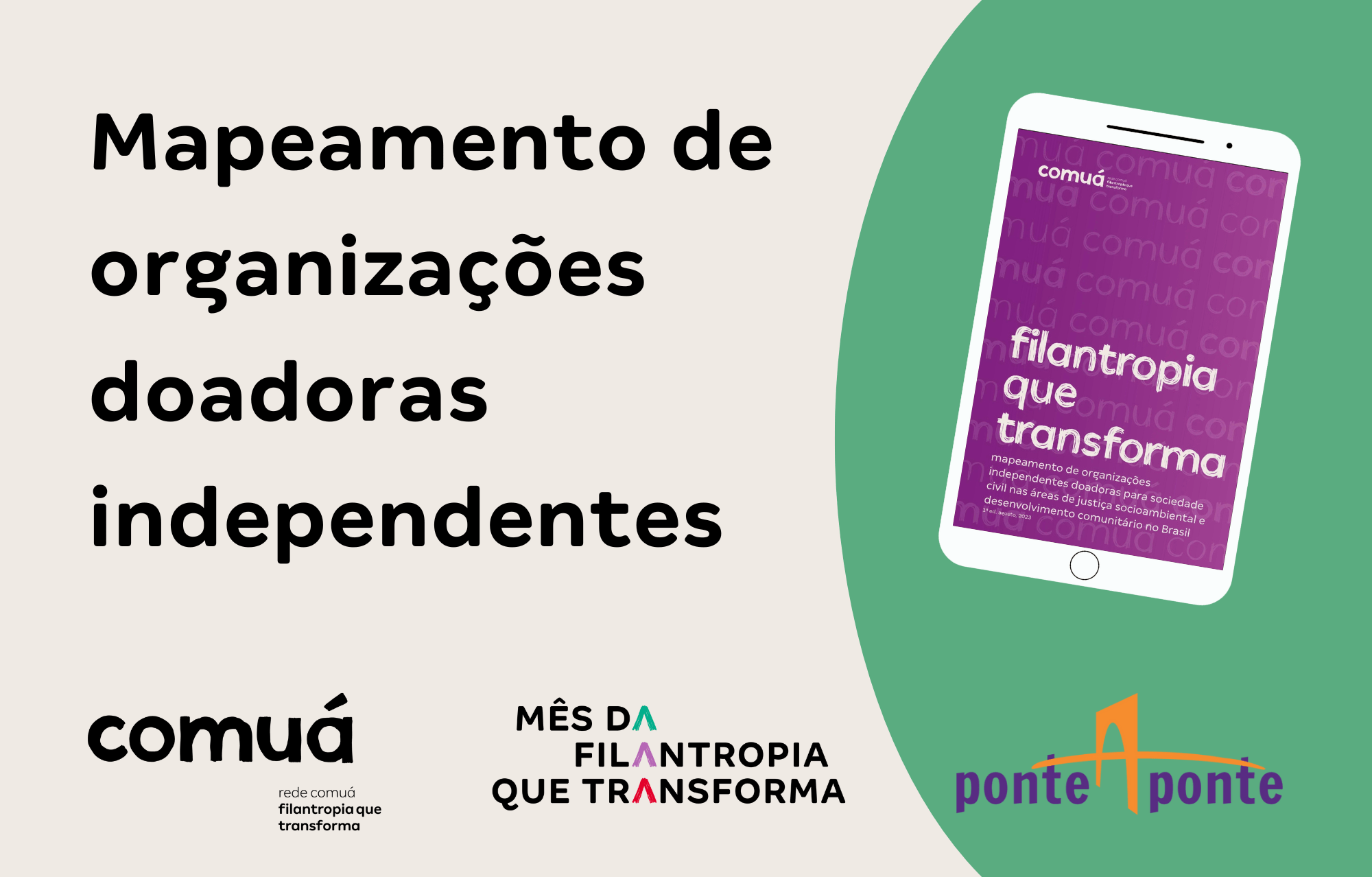
Rede Comuá, in partnership with bridgepoint, launched, on September 5th, the publication “Philanthropy that transforms: mapping of independent donor organizations for civil society in the areas of socio-environmental justice and community development in Brazil”.
The online event was attended by 165 people, and had as guests Cássio Aoqui, from bridgepoint; Cristina Orpheo, from Casa Socioambiental Fund; Gelson Henrique, from PIPA Initiative; and Ese Emerhi, from Global Fund for Community Foundations. The mediation was carried out by Graciela Hopstein, executive director of Rede Comuá.
In her opening speech, Graciela highlighted the research as important for the field in terms of giving visibility to a different way of doing philanthropy:
“An independent philanthropy focused on supporting civil society initiatives in the areas of socio-environmental justice, human rights and community development. The research, in general terms, indicates that we are in a growing field in Brazil and the Global South. It provides revealing information about the performance of the funds, both in the field of support (such as donations, thematic areas, audiences involved), and also about the nature of these funds – how they were created, partnerships, funders, budgets and governance structures. The study shows the diversity of the field of independent philanthropy and also its complexity: it is a heterogeneous field, with elements of action in common, but based on the multiplicity of organizations involving thematic funds, community and/or territorial funds and community foundations . This is the first edition of the survey, and we hope to update it over the next few years.”
Cássio Aoqui, from PonteAponte, began his speech by reiterating the points raised by Graciela, and pointed out, citing the mapping's introductory text, that it is an advocacy document, and it is even important that it comes to provoke reflections on and for the field of philanthropy.
“To participate in this mapping, an important point is that organizations mobilize resources in a diverse way, not just depending on one donor. Mobilize diverse sources and make donations and structured support to associations, collectives, groups, movements and social leaders as a whole. A philanthropy that has independence and this perspective of transferring power. This is an exploratory study, perhaps the first of its kind, and it aims to open new paths. The research instruments were co-created, there was a lot of collective learning in the process too”
Among the data presented in the publication, Cássio highlights the priority given by these organizations to institutional strengthening, because this type of support strengthens civil society institutions that work in the fields of socio-environmental justice and human rights in Brazil. And also the fact that there are organizations that donate financial resources and also carry out projects in their own territories.
“We are talking about organizations that were born in the territories, with a place to speak, legitimacy, and many of them, at some point, also start making donations. Thus, there ends up being synergy between territorial action and acting as a donor organization. It’s an important nuance in relation to conventional philanthropy.”
Diversity, innovation and ancestry
Cristina Orpheo, from the Casa Socioambiental Fund, states that the publication shows the advancement of community philanthropy in Brazil, recognizing the leading role of local actors in the transformation processes in the territories.
“We have quilombola funds, indigenous people, extractivists, women who break coconuts, a diversity of arrangements as well. I think that in the last four years the importance of resources reaching the base to defend democracy has become much more evident. I draw attention to donated amounts. When we talk about these resources, we are talking about resources coming directly to these communities, which will define what to do with them in accordance with their priorities. It is of gigantic relevance. We have a discussion in private social investment (ISP), about how to combat structures of inequalities. One of these possibilities involves strengthening and recognizing these mechanisms for making resources reach the base. And that the leading role of local communities as the main political actors in confronting inequalities is recognized.”
Gelson Henrique, from the PIPA Initiative – the organization that launched this year the research “Peripheries and Philanthropy – The barriers to access to resources in Brazil” – points to the importance of the research as revealing another philanthropy that takes place, and which looks at places and territories where access to resources is scarce or non-existent.
“A philanthropy that transforms from foundations and independent funds that can understand our causes, from movements on the periphery. This research shows that there is an experience that exists in the country, which needs to be systematized and influence what we have in traditional philanthropy. That there is a lot to learn from community philanthropy. In the research, we realized that one of the main forms of support is aimed at institutional strengthening. And at PIPA we understand that this is a field that needs donations. And in the philanthropy we have today, this has not been a priority. Working to strengthen institutions in Brazil is innovative.”
Gelson also defends the importance of talking about decoloniality in philanthropy, because traditional philanthropy (main stream) “is colonial in its concept and practices. The decision of where the resource goes is political. This research shows and lights a signal that there are other ways of doing things than those that are historically established today. And they need to be strengthened as an agenda in the field. This research scenario shows a great revolution in what we have as philanthropy today, in terms of who accesses resources. A cohesion of what we can offer to this field and provoke, because it is in dispute. Financing these organizations is strengthening the territories and making our existence possible.”
The event also featured the participation of Ese Emerhi, from the Global Fund for Community Foundations, who highlighted the global movement #SshiftThePower and how mapping presents synergies with it,
“Showing clear data on how people are financing social justice and solving their own problems. It may seem like something new, but it's an ancestral way that we've been using to solve our problems for hundreds of years. The new word may be philanthropy, but giving and supporting one another has always been there. In Africa, for example, independent funding is promoting similar work. And the GfCf also seeks alternative ways of financing. This study is very powerful, and I will do my best to ensure that everyone in my network has access to it.”
Publication with this focus is a pioneer in the field of philanthropy
Mapping makes a fundamental contribution to deepening knowledge and giving visibility to a group of donor organizations (grantmakers) that began to emerge 20 years ago in the country, supporting with financial resources initiatives of community-based groups and social movements that work in the fight for access and recognition of rights in the areas of socio-environmental justice, human rights and community development.
It was conceived not only as a study aimed at bringing new knowledge about a different way of doing philanthropy - perhaps little known, but innovative -, but as an advocacy instrument, capable of raising new reflections, questioning power relations - including from the perspective of the ShiftThePower movement – and the colonial practices of philanthropic practice.
The mapped organizations are based in the five regions of Brazil. In ten states and 11 municipalities. The southeast concentrates 58%, followed by the North region, with 23%; Northeast, with 13%; and Central-West and South, with 3% each. The fact that they are located in these regions does not restrict their operations to these territories. In fact, there are organizations that operate territorially, but also those whose scope of action covers different regions of the country.
Institutional strengthening is a priority for independent donor organizations – 74% declare to donate for this purpose. Neglected in the conventional logic of project financing, in this case institutional strengthening is understood as fundamental for the sustainability of actions and the understanding that this investment is fundamental for the strengthening of organizations that work in the defense of rights. This support is flexible, giving group organizations autonomy in making decisions about their actions.
Following this, priority is given to donations on gender and women's rights and culture (48%), community development (42%), family farming, urban agriculture, agroecology and agroforestry (39%) and indigenous, quilombola, riverside and traditional communities (35% ). For most donor organizations, areas of support are intersectional.
Thus, the pioneering and innovative character of the organizations mapped in directing resources to initiatives that are often neglected by a large part of the Brazilian philanthropic ecosystem remains evident. This mapping provides data that allows us to affirm that the actions of independent donor organizations are essential to make resources reach non-formalized collectives and movements, democratizing access to resources.
The publication is now available for download in the Rede Comuá library, and an English version will soon be published. If you missed the launch, watch on the Rede Comuá channel.