This article is a response from Rede Comuá to the text published by João Paulo Vergueiro entitled “Decolonizing philanthropy is a concept that does not fit in Brazil”
Let's decolonize philanthropy, yes!
Rede Comuá has been guiding the discussion on the decolonization of philanthropy for some time, both through published articles and debates held in various spaces, both nationally and internationally.
To position ourselves before the thesis that decolonization is a concept that does not fit in Brazil, it would be enough to mention the article published by Graciela Hopstein and Allyne Andrade in Alliance Magazine in 2022 and translated by Rede Comuá into Portuguese, published on the blog of Comuá Network “The decolonization of philanthropy is advancing” .
In any case, to start the debate, we believe that it is worth recalling here some fundamental arguments, presented in the aforementioned article, constructed from a material analytical perspective (and which do not only imply a discursive logic). Our idea here is not only to refute this thesis, but to affirm that we actually live in a society permeated by the existence of colonial pacts, practices and visions. And finally, we need to understand that the field of philanthropy as a human and social activity is inseparable from the dynamics that permeate society as a whole.
According to Anibal Quijano, the concept of coloniality or colonial logic must be understood to characterize the typical pattern of global domination in the modern capitalist system, whose origin goes back to European colonialism at the beginning of the 16th century based on the dominance of “models of control of subjectivity , culture and especially with the production of knowledge” [1]. As indicated in the article by Graciela and Allyne, the author identifies the following as the most important elements of Eurocentrism:
a) a marked articulation of dualism (pre-capitalist/capitalist, non-European/European, primitive/civilized, traditional/modern, etc.) and the linear, unidirectional evolution from a state of nature to modern European society; b) the rationalization of cultural differences between human groups derived from the notion of race; and c) the temporal-distorted view of all these differences by seeing non-Europeans and their culture as anachronisms (Andrade and Hopstein, 2022) [2].
Here we have a first major contradiction in relation to the arguments presented by João Paulo Vergueiro: the concept of coloniality does not arise in the global north, but in Latin America, with Quijano as one of the great reference authors, in the same way as María Lugones, among others. Therefore, it is not an appropriate or adapted concept, quite the opposite. Carrying out a good review of the literature is essential when you intend to challenge positions of this magnitude. The bibliography is vast and the discussion on this topic has a long history, which begins with the concept of post-coloniality in Portugal, later redefined in Latin America as decoloniality and, more recently, based on the review of African authors, we have debates centered on counter-coloniality.
Secondly, arguing that it is a “counterproductive error” to talk about decolonizing philanthropy when we do not have a consolidated Brazilian philanthropy – as highlighted in the original text itself, which is still not recognized and valued – is a mistaken argument because it somehow intends to deny the existence of the reproduction of colonial power relations in the field of philanthropy. And, furthermore, stating that “it belittles those who already donate and tends to alienate those who might donate, labeling people as exploiters and profiteers” is a reductionism of the problem, removing all complexity from the debate.
Unfortunately, this is what has been happening in the field of national philanthropy in general: There is a tendency to avoid going deeply into strategic debates, simplifying thoughts. At the same time, the practices of co-opting strategic actors and appropriating narratives, without material support, give rise to reductionism and emptying of agendas, a situation that at the same time reveals the existence of yet another set of colonial practices in the field. Also the existence of initiatives that operate by going over the top, destroying everything, installing world views from the top down, is certainly another example of colonial practices in philanthropy. And we still have to face great conceptual paradoxes such as, for example, when collaboration is established only as a speech in the best style commodity for export.
Not knowing that there are colonial practices in society and that this directly reflects on Brazilian philanthropy is a way of turning one's back on political minorities, on relationships of subordination and oppression, on the presence of different groups that fight for rights and want to have a space in Brazilian philanthropy. , mainly in accessing resources in a flexible way, aligned with your agendas.
Stating that Brazilian philanthropy is permeated by colonial views and practices is uncomfortable, put your finger on the wound, shakes and questions the actions of traditional actors who have the power of money and, therefore, also of decision-making. Setting up this discussion forces them to leave their comfort zone, their place as protagonists. Abandoning privileges implies give up of power and exclusive access to wealth and, certainly, this is the great challenge we have as a society and not just in the field of philanthropy.
As argued in the article by Allyne and Graciela, data from the 2020 GIFE Census [3] indicate that there are striking traces of colonial practices in Brazilian philanthropy when it is timidly donated to civil society and, as a result, does not recognize the importance and the power of this sector in struggles and processes of social transformation. Furthermore, the data also shows that political minorities are not the priority, since only 5% of the philanthropic organizations associated with GIFE directly finance initiatives focused on racial issues; 9% for women; 3% for LGBTIQA+ communities and 4% for people with disabilities. It may be that the 2022 edition will show some advances, but we believe that they will still be timid because we start from the premise that transformation processes take time and great effort, especially dialogue and knowing how to deal with difference.
For us, at Rede Comuá, the fundamental starting point to advance on the path of decolonization of Brazilian philanthropy is to promote a process of deep reflection on historical practices, installing a movement of permanent deconstruction and a way of acting in social reality, without imposing quick solutions from top to bottom, but rather, strengthening voices and recognizing the power of communities to seek their own ways to face problems. The #ShiftThePower movement that we join indeed has this agenda [4].
The practice of trust-based donations has proven to be a way of working strategically to recognize the power of territorial initiatives and political minorities that fight for access and recognition of rights. The thematic, community funds and community foundations that make up Rede Comuá – which historically operate in the area of independent local philanthropy – have been providing crucial donations to NGOs, grassroots organizations, social movements and defenders of access to rights in Brazil. Thus, Comuá members seek to carry out a different type of philanthropy based on decolonial practices [5].
Donating to grassroots communities shows that the focus is on recognizing the strengths of civil society organizations, thus contributing to promoting transformations at various levels. Another argument here that goes against the thesis of the danger of talking about decolonization, since the donation of independent philanthropy is significant in the field of socio-environmental justice, which must be understood as a strategy to combat colonial practices and break down several status quo. In fact, Rede Comuá and its members have directly donated, from the moment of creation of each one until today, a total of 670 million reais to Brazilian civil society.
The decolonization process seeks to detach itself from the extractive and exploitative practices of the past. This implies a radical transformation, based on new alliances between territories and social actors, which leaves no room for a return to the previous state of conformity with the dominant and symbolic colonial power.. Truly transformative philanthropy cannot turn its back on these problems. In fact, this is the starting point for having a consolidated philanthropic field, because decolonizing implies recognizing diversity, the multiplicity of actors and practices and, above all, the importance and transformative power of civil society.
Rede Comuá – philanthropy that transforms
[1] QUIJANO, Aníbal. “Coloniality of power, Eurocetrism and Latin America”. LANDER, Edgardo (org). The coloniality of knowledge: Eurocentrism and social sciences. Latin American perspectives. CLACSO, Buenos Aires, Argentina. 2005.
[3] See: https://sinapse.gife.org.br/download/censo-gife-2020
[4] See: https://globalfundcommunityfoundations.org/what-we-stand-for/shiftthepower/
[5] See: https://www.youtube.com/watch?v=oE9bo1z1PhI
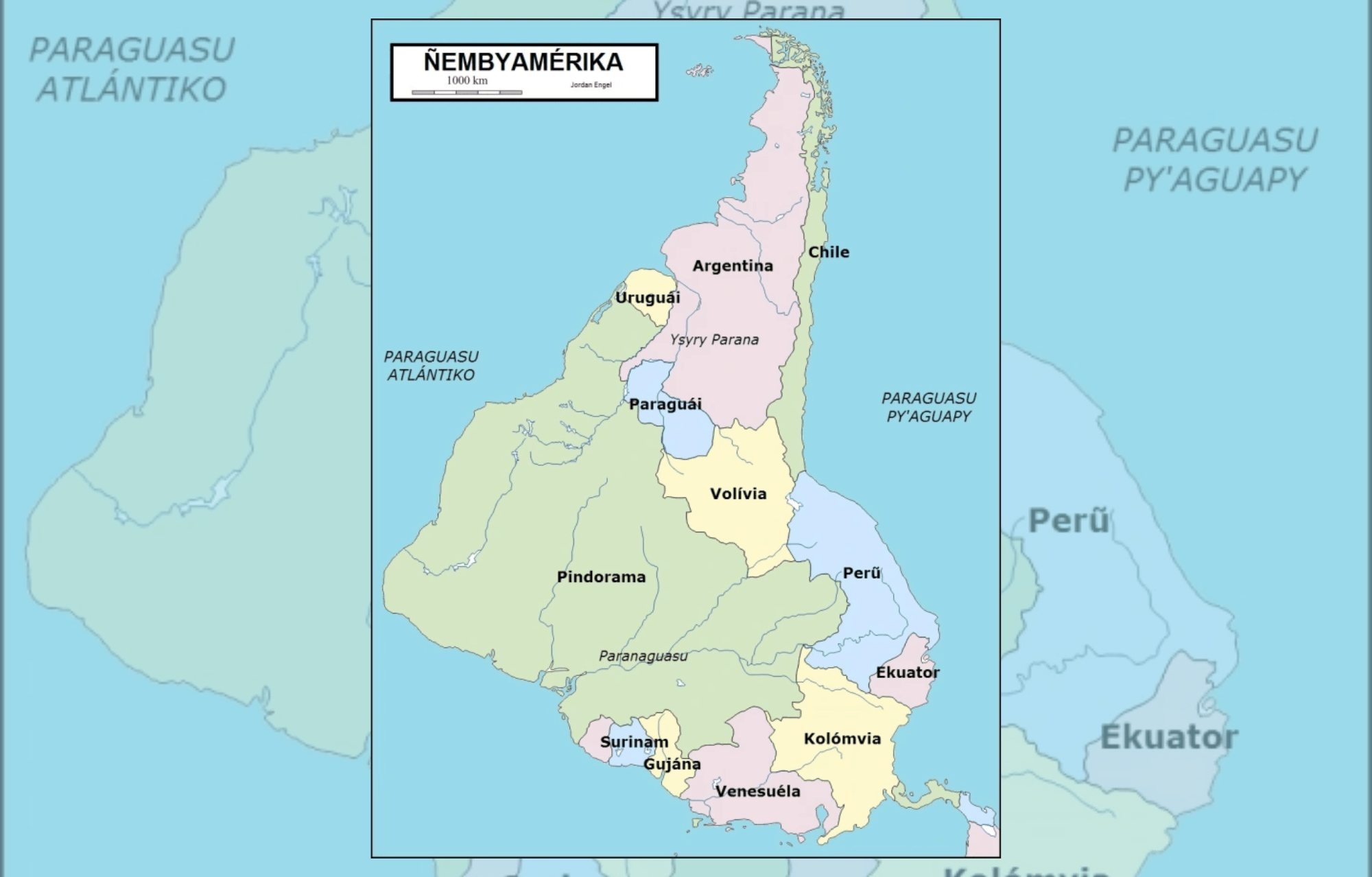
Cover: https://decolonialatlas.wordpress.com/ – Ñembyamérika (South America) in Avañe'ẽ (Guarani) by Jordan Engel