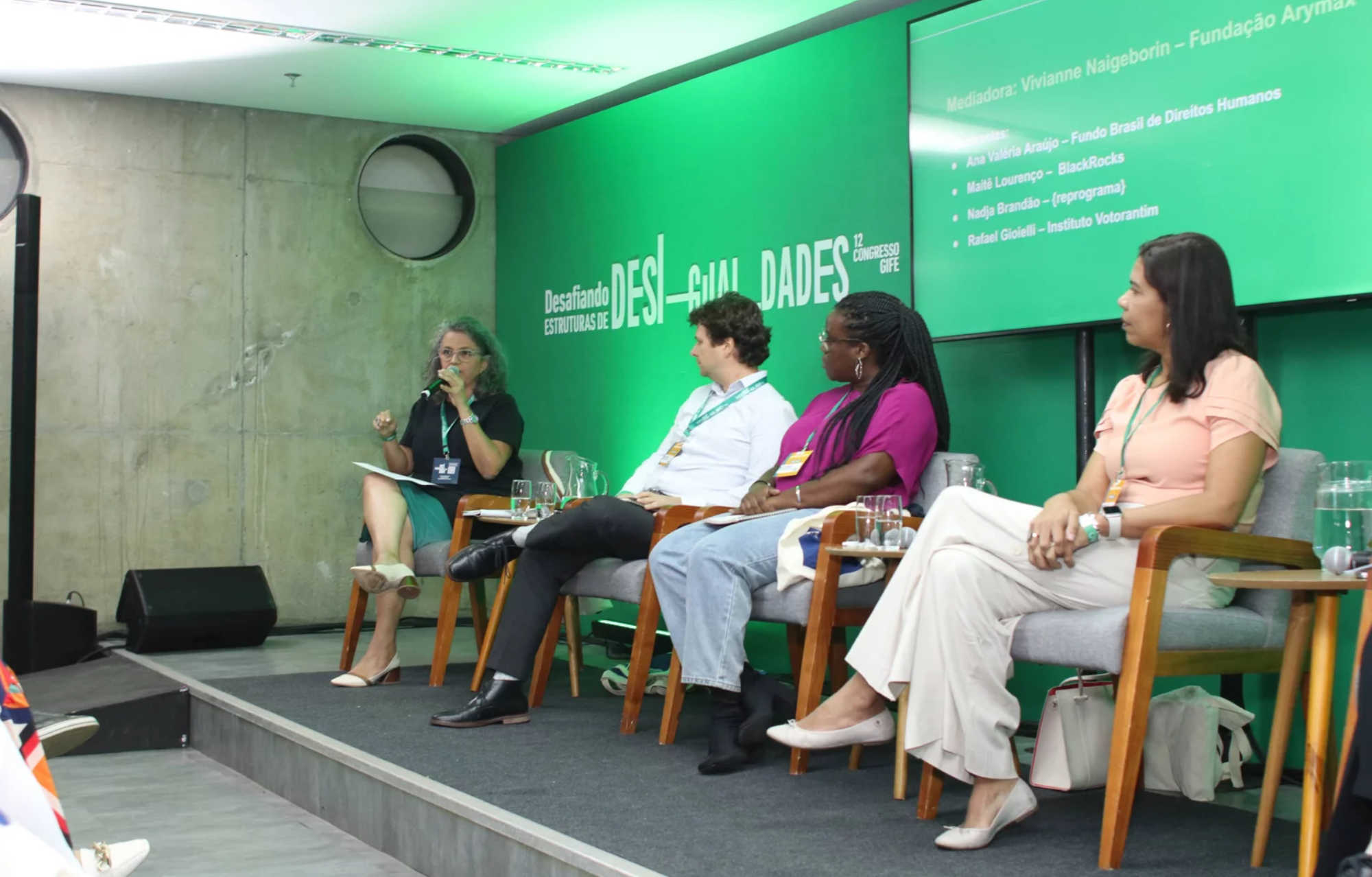
For Ana Valéria Araújo, superintendent of the institution, philanthropy must support organizations that defend labor rights and compliance with constitutional guarantees
By Rafael Cistati
Almost half of Brazilian workers today live informally. These are people who do not contribute to social security and who, therefore, do not have access to rights such as unemployment insurance or sickness benefit. Informal workers represent more than 40% of the workforce: a portion that has grown in recent years, especially after 2017, when the labor reform was approved. “The argument was that the reform would create jobs. It didn’t,” says Ana Valéria Araújo, superintendent of the Brazil Fund for Human Rights. “Today, 40% of Brazilian workers sell their labor without having access to rights.”
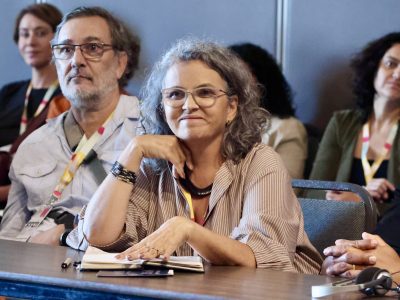
On April 13th, Ana Valéria participated in the discussion panel “Productive inclusion and promotion of decent work” during the 12th Congress of the Group of Institutes, Foundations and Companies – Gife. Held in São Paulo, the event reflected on the role of philanthropy in combating inequalities.
In addition to Ana Valéria, the panel was made up of Maitê Lourenço, founder of BlackRocks; Nadja Brandão, executive director at {reprogram} and Rafael Gioielli, general manager at Votorantim Institute. The conversation was mediated by Vivianne Naigeborin, superintendent of the Arymax Foundation.
“We understand productive inclusion as the insertion of vulnerable people into the world of work”, explained Vivianne at the opening of the debate. It is a universe that, according to her, is going through a process of accelerated transformation.
In recent years, sometimes due to legal changes, sometimes due to the adoption of new technologies, labor relations in Brazil have changed. In general, the scenario has deteriorated. “We are living in a time of modernization of labor relations in which labor rights are identified as barriers to economic growth”, pointed out Ana Valéria during the event.
The result was the proliferation of precarious and poorly paid occupations. Data from the International Labor Organization (ILO) indicate that, to receive the equivalent of a minimum wage, digital platform delivery people need to maintain working hours that exceed 65 hours per week. “Not infrequently, these workers are on top of a motorcycle. They are tired. If they are involved in an accident, it is not considered a work accident”, said Ana Valéria. “That’s what we’re talking about when we talk about vulnerability.”

According to the superintendent of the Brazil Fund, given such precariousness, it is not possible to talk about productive inclusion without talking about promoting decent work: work that respects rights, is carried out safely and results in fair remuneration.
For Maitê Lourenço, from Blackrocks, this is a discussion that needs to be racialized. “We increasingly use new terms to mask old problems,” he said. “When we talk about productive exclusion, we are talking about racism.” Viviane, from Arymax, highlighted that “Brazil has a history of systematic exclusion of many groups, which goes through slavery and continues in the post-industrialization period, valuing productivity more than people”.
In the debaters' opinion, despite the delicate scenario, it is possible to reverse this situation — and move forward. Ana Valéria believes that the proposed solutions must necessarily resume guarantees guaranteed by the 1988 Federal Constitution. “The Charter was a historic milestone in the trajectory of workers – it elevated the right to work to the condition of a fundamental right”, recalled the superintendent. This achievement was the result of years of mobilization by organized civil society.
According to Ana Valéria, in a scenario of deterioration of labor guarantees, It is up to philanthropy to support organizations that work to promote rights in the field of work. “This is a collective task of Brazilian society, to realize constitutional rights.”
It is in this key that the Brazil Fund works. In December 2022, the institution launched Labora – a decent work fund. The initiative is a collective creation effort by the Brazilian Human Rights Fund, Laudes Foundation, Ford Foundation and Open Society Foundations. The project, with an initial investment of US$ 8.5 million (around R$ 45 million), aims to support and strengthen civil society on its multiple fronts of struggle for decent work, seeking to overcome the racial and gender inequalities that structure the Brazilian society and promoting the consolidation of a robust and autonomous social field in this struggle. Labora's first notice was launched in December, and should select 25 organizations that will receive support. The results will be released on May 1st.