By Graciela Hopstein
We are just a few days away from the second round of Brazilian elections (scheduled for October 30), which will elect a new president for the next four years. In the opinion of several analysts, it is possible that this is the most challenging moment in recent times, or even in the history of Brazil. It is important to highlight that voting in Brazil is mandatory, so Brazilians will go to the polls to choose between the re-election of a far-right candidate, Jair Bolsonaro, and a former president, candidate of the Workers' Party (PT), Luiz Inácio Lula da Silva, who governed the country for two consecutive terms, between 2003 and 2010.
The October electoral campaign (second round) was marked by large investments by the government in social benefits, through financial allocation programs (contrary to current laws and exceeding the limits of the public budget), acts of violence, threats, electoral harassment of employees of companies by some of Bolsonaro's followers. Brazil is still one of the biggest creators of misinformation and false news (“fake news”) in the world. The data is impressive: there was a 1,671 percent increase in the volume of misinformation complaints sent to digital platforms compared to 2020; cases of political violence through social media have also skyrocketed, increasing by more than 400 times compared to 2018. Everything indicates that disinformation has become an epidemic and the main means of political management used by the extreme right in Brazil.
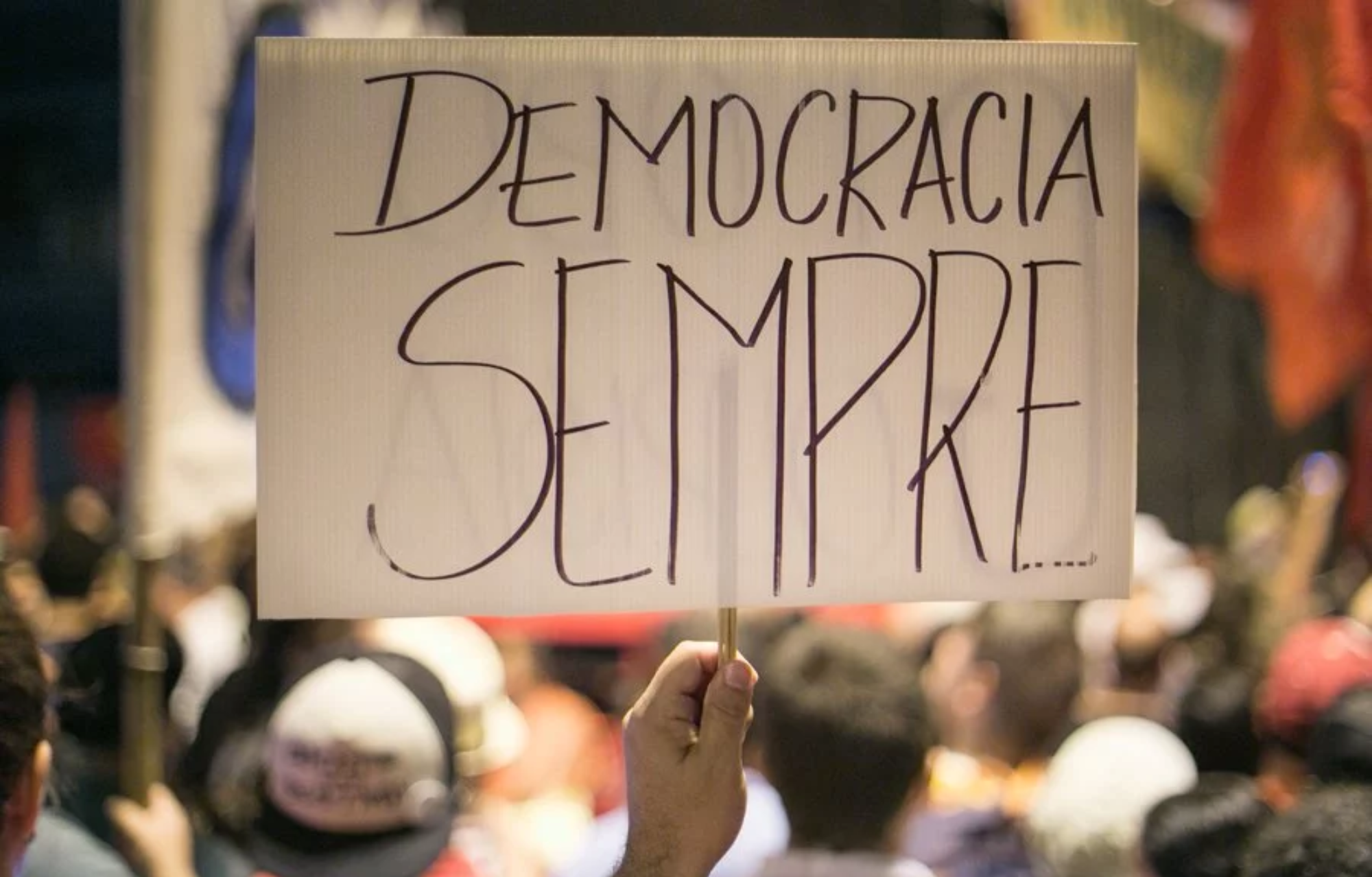
In addition to the results of the Lula and Bolsonaro governments and the proposals of the two candidates, in the current scenario, what is at stake in Brazil is the choice between the defense of democracy (in the broadest sense) and an extremely conservative regime, based on 'traditional family and good customs', the arming of the civilian population, the propagation of hatred and extermination of political minorities, and the systematic destruction of the environment through the massive and illegal exploitation of natural resources.
The fight for democracy in Brazil
Since 2019, Brazil has been facing major challenges linked to an increasingly adverse and regressive political scenario, specifically in terms of the recognition of rights achieved in past decades. The closure of civic and participatory spaces, permanent threats to civil society and democracy, and disinformation (through the systematic dissemination of fake news) are some of the political actions carried out by the current government. Not to mention the dramatic management of the pandemic during the Bolsonaro government, which left a death toll of almost 700,000. The scenario marked by necropolitics, denialism, questioning of science and issues related to the field of rights, evidently put at risk and compromised the institutions conquered and strengthened since the redemocratization process (1988).
The conservative wave we are experiencing in Brazil and around the world is certainly a reaction of power to the advancement of socio-environmental, racial, gender and ethnic justice, LGBTIQ+AP agendas, which have evidently strengthened and diversified the field of access and recognition of rights, and must be understood as achievements of the movements’ struggles. According to Foucault, if there is a power relationship, there is the possibility of resistance. For the author, resistance comes before the power that is installed through the processes of capturing the power of movements and transformation.
At the same time, it is important to reinforce that democracy is not limited to the act of voting, but is linked mainly to the recognition of the rights – 'having the right to rights' – of free expression, association and dignified life (buen vivir). Strengthening democracy implies at the same time combating racism, homophobia, machismo, misogyny, among many other forms of discrimination.
Space for the influence of philanthropy
It is in the field of rights that philanthropy and democracy connect: from supporting financial and non-financial resources to civil society groups, organizations and movements to build agendas in the field of defending human rights, socio-environmental justice and community development. Supporting community-based initiatives is a fundamental strategy to strengthen actors in the fight for the recognition of rights and, therefore, in favor of strengthening democracy.
In the current political scenario, it is urgent to act to transform the field of philanthropy, democratizing access to resources, expanding its distribution system (another point in which philanthropy and democracy are related), connecting it with social demands and maintaining dialogue permanent relationship with civil society. To achieve this, it is necessary to institute a process of deconstruction, thinking about ways to overcome and abandon colonial thoughts – based on white, masculine and heteronormative Eurocentrism – and binaries – centered on socially constructed opposites – questioning power relations, the imposition of agendas and actions, and avoiding reproducing relationships of oppression and subordination. It is also essential to introduce changes in philanthropic organizations with a view to the gradual inclusion of professionals belonging to diverse and minority political groups.
We need to think politically about the field of philanthropy because, in fact, life and our very existence are political. Including this dimension is fundamental to understanding its connection with the real world and even to reflecting on the role played by philanthropy in transformation processes in the social field (in the broadest sense). Because transforming implies breaking pre-existing pacts based on patrimonialism, racism, machismo, etc. (ShiftthePower).
In recent years, Brazilian philanthropy has undergone considerable changes. Brazil has a well-developed philanthropic ecosystem (even when compared to countries in the LA region), with a great capacity for mobilizing resources. In the context of the pandemic, the ability of business and family philanthropy to mobilize resources to face the crisis and emergency situation became clear. However, these resources do not reach civil society in a significant way, given that most local philanthropic organizations are not predominantly donors. And although these trends are slowly changing, we still see that the main donors in this sector are, more than independent funds, international philanthropic organizations.
In the current scenario, social and community justice philanthropy occupies a strategic position specifically in the defense of rights, in the recognition of differences, diversities and intersections, operating through rhizomatic networks, recognizing the strength of connections in continuous processes of change. It is a philanthropy based on trust, which recognizes civil society and communities as fundamental parts for the transformation and strengthening of democracy.
Certainly, the organizations that work in this field, specifically the independent funds (thematic and community) that are part of the Philanthropy Network for Social Justice – currently Rede Comuá – were and continue to be strategic because they donate resources to society on a permanent basis, recognizing their local protagonism in struggles for access to and defense of human rights and social justice. In fact, it can be said that, in the current political scenario, it is these philanthropic organizations that effectively contribute to supporting struggles, resistance and the strengthening of democracy in Brazil.
Graciela Hopstein is Executive Director of Rede Comuá.
*Text originally published on the Alliance digital magazine website in English and translated for the Rede Comuá blog: https://www.alliancemagazine.org/blog/elections-in-brazil-what-is-the-relationship-between-philanthropy -and-democracy/
Cover Photo: Guilherme Santos/Portal Sul21 / reproduction