Mapping identifies independent organizations that work with donations to civil society groups and movements that work in the areas of social justice and community development in the country
By Monica C. Ribeiro
Carried out by Rede Comuá in partnership with PonteAponte, the mapping of thematic, community funds and independent community foundations that work with donations to civil society organizations in the areas of social justice and community development identified 31 of them in different regions and priority agendas.
The mobilization of financial resources from diverse sources and the direct donation of resources to civil society initiatives in the areas mentioned above are the main characteristics that delimit the universe of this mapping, which sought to identify independent philanthropic organizations. In turn, indirect donations, the processes of joint construction of notices and continuous communication define the modes of operation of this set of identified organizations.
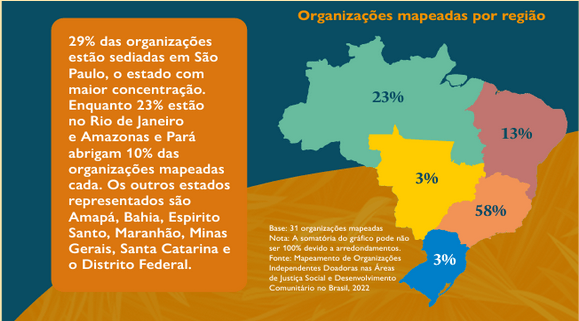
The mapped organizations are located in 10 Brazilian states and the Federal District: 58% in the Southeast region, 23% in the North, 13% in the Northeast and 3% in the Center-West and South regions. These data reveal that this form of philanthropy occurs throughout the country.
In common, donations made by independent philanthropic organizations are based on the idea that the use of resources and decision-making power are the responsibility of those who receive the donations, with them being the protagonists in their actions.
The organizations mapped contribute to issues of racial equality, indigenous and traditional populations, the environment, gender, sexuality, among others, and which focus on populations that have historically been denied their rights.
The donation of financial resources – through diversified investment strategies grantmaking – for civil society organizations and initiatives, it has proven to be one of the relevant ways to contribute to their strengthening and support for struggles for recognition and access to rights, in a broad sense, led by groups, collectives and movements alongside political minorities.
Within the mapped universe, it was also possible to observe organizations that work for community development in a specific location, connecting the territorial focus with social justice themes.
Emergence and profile of mapped organizations
The emergence of independent local funds from the 2000s onwards entailed a process of transformation not only in Brazilian philanthropy, but also in civil society, because they established themselves as an effective alternative for financing and strengthening small and medium-sized organizations and movements that operate in the field of social justice and community development.
The 2000s were a period characterized by the withdrawal of international cooperation and philanthropy, motivated by the understanding that Brazil had a stable and developing economy and a democracy and solid institutions. Certainly, this process created a huge vacuum in the financing of civil society organizations and initiatives, a situation that impacted their financial sustainability and in some cases led to the definitive closure of non-profit institutions.
In this context, the independent funds that emerged throughout this period (between the years 2000 and 2010) occupy a strategic place to respond to the financing crisis, as many of them were created by activists from the movements, with solid knowledge about the field, its needs and demands, and with the ability to articulate in national and international networks.
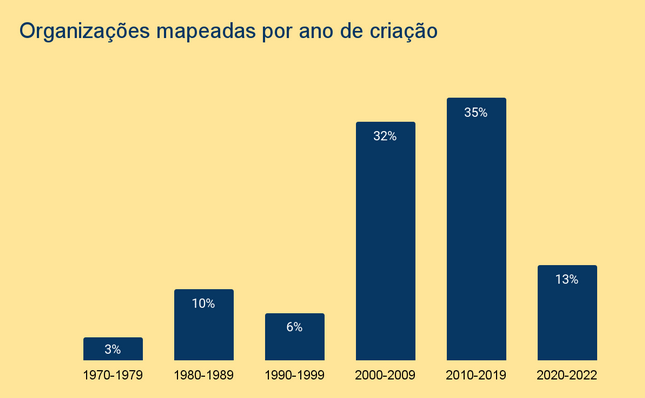
During this period, the following were created: Elas + Fund, BrazilFoundation, Casa Socioambiental Fund, Brazil Human Rights Fund, Icom and Instituto Baixada. Taking into account the need to expand civil society financing and the successful model of independent philanthropy, from 2010 onwards a new group of philanthropic organizations began to emerge, inspired by the experiences of the funds created in the previous stage which, at the same time, contributed to its foundation and development through sharing learning, and even through financial support, with the aim of strengthening and expanding the field.
In this group we can identify the Baobá Fund, iCS, Casa Fluminense, FunBEA, Positivo and more recently the Procomum Institute, Podáali – Indigenous Fund of the Brazilian Amazon, community organizations, such as the Babaçu Fund of the Interstate Movement of Babaçu Coconut Breakers (MIQCB) and Agbara Fund.
Base: 31 organizations mapped
Note: The sum in the graph may not be 100% due to rounding.
Source: Mapping of Independent Donor Organizations in the Areas of Social Justice and Community Development in Brazil, 2022
Base: 31 organizations mapped
Note: The sum in the graph may not be 100% due to rounding.
Source: Mapping of Independent Donor Organizations in the Areas of Social Justice and Community Development in Brazil, 2022
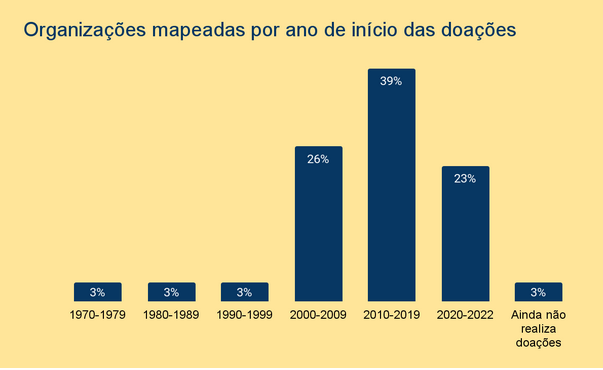
The research reveals that among the organizations mapped, 55% started their activities by donating financial and non-financial resources, 26% only with non-financial support and only 16% started their activities only with financial donations (1). These data reveal that independent organizations managed to structure themselves in the short term to act in the field of donations and in strategies to strengthen civil society.
_____
(1) 3% of the mapped organizations had not started their planned operations, financial and non-financial donations, until August 2022.
The presence of these organizations in the philanthropic ecosystem gained prominence from the year 2000 and continues to grow with each period. It is important to highlight that 23% in the mapped universe is made up of “new organizations” that began donating between 2020 and 2022, information that indicates that the independent philanthropy movement has gained new momentum.
With the increase in donor organizations, the themes of activity are also becoming more diverse. From 2000 onwards, gender agendas, promoting racial equality and combating racism and community development became more present in the activities of the mapped organizations. It is during this period that we see the emergence of organizations such as ELAS+ Doar para Transformar, which focuses on donating organizations and movements of women and trans people, as well as the Positive Fund, the Brazilian Human Rights Fund and the Baobá Fund.
Directing donations to indigenous, quilombola, riverside and traditional communities and to socio-environmental and family farming projects also becomes a focus of prominent action, with the work of organizations such as Fundo Casa Socioambiental, Fundo Dema and Instituto Juruti Sustentável – IJUS, which they operate in specific regions of the Brazilian Amazon territory.
The themes of culture, education, youth and entrepreneurship began to be highlighted as a priority between 2000 and 2009. However, it is among the organizations created from 2010 to 2019 that they gain greater relevance. In turn, it is important to highlight that Fundo Positivo is the only organization mapped that works to promote rights in the health field with a focus on initiatives aimed at STIs and HIV.
The research also identified new independent philanthropic initiatives such as university funds represented in this research by Semper FEA, professional association funds, such as the Associação dos Profissionais do Audiovisual Negro, and organizations such as Instituto Procomum, from Baixada Santos, and Silo – Arte e Latitude Rural, located in Serra da Mantiqueira, which mobilizes resources and redistributes them through community development projects in the territory.
Mapping expands knowledge about the activities of this philanthropy
Of the 31 organizations mapped, 29 are formalized with their own CNPJ; those that do not have a CNPJ were constituted as funds within the structure of a supporting or guardian organization, which in addition to acting as fiscally responsible, also contributes institutionally to the maintenance of the organizations, but with independence of action and its own governance.
While 52% of the mapped organizations have a budget between R$ 2 million and R$ 25 million, their 32% budget is less than R$ 1 million. Among the sources of resources for these organizations, donations from international philanthropic organizations are most frequent (87%), although the participation of Brazilian philanthropic organizations and other national sources is also relevant. 68% of mapped funds and foundations declare that funders have no influence over the use of resources, decision-making processes and governance.
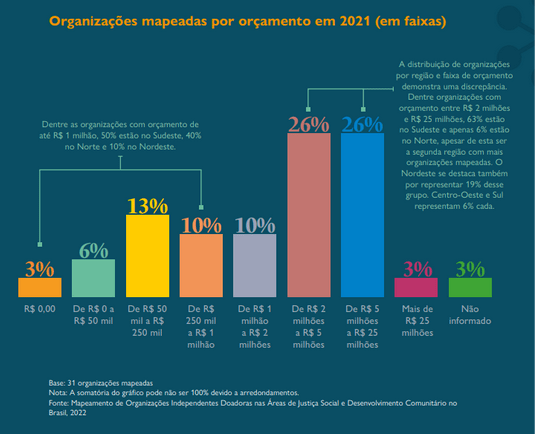
Looking at the budget ranges, it is clear that the distribution of organizations mapped by budget is one of the indicators of the diversity of this universe: 52% of the mapped organizations have budgets between R$ 2 million and R$ 25 million, and 32%'s budget is lower to R$ 1 million.
Among the organizations with a budget of up to R$1 million, 50% are in the South East, 40% in the North and 10% in the North East. The distribution of organizations by region and budget range shows a discrepancy, as among organizations with a budget between R $2 million and R $25 million, 63% are in the Southeast and only 6% are in the North, despite this being the second region with the most organizations mapped . The Northeast also stands out for representing 19% of this group. Central-West and South represent 6% each.
Among the themes of action of the mapped organizations, the main one is institutional strengthening (74%), followed by gender and women's rights (48%) and culture (48%); Topics related to communities, local development and traditional peoples also stand out, such as community development (42%), family farming, urban agriculture, agroecology and agroforestry (39%), and indigenous, quilombola, riverside and traditional communities (35%).
Civil society organizations that receive donations sometimes face difficulties in accessing financial resources because traditional public and private investments are not always distributed in an inclusive and flexible way to meet demands with their own priorities and ways of doing things. Independence of action is a way of distancing oneself from these arrangements and is a mark of the profile of the organizations mapped, in which financiers do not interfere in the destination of financial resources or, when this occurs, participation occurs on an equal basis with other actors and in a guided manner by governance structures established by the organization itself.
In this way, it is possible to identify examples of organizations that sought to work for this autonomy and independence and their relationship with the supported organizations. Through these examples, it is possible to notice how the very constitution of these organizations comes from the perception of the demands of the supported organizations or territories. These organizations work in partnership to support and guarantee the autonomy and independence of those supported, establishing relationships of trust.
The Association of Remaining Quilombo Communities of the Municipality of Oriximiná (ARQMO), for example, located in Pará, has existed since 1989, and in 2018 began making donations (grantmaking) for the eight associations of quilombola communities in the region. One of the reasons that led them to make donations was the perception that executing their own projects, with the intermediation of CSOs from outside the territory – who often have no contact with the local quilombola reality – did not generate ownership of the projects and lasting results for the communities. communities.
Another example of the search for autonomy is that of the Dema Fund, created in 2003, following a mobilization to dismantle a scheme involving loggers who used auctions to seize resources illegally extracted from the Amazon to legalize the wood and enable its sale. Social movements in the Amazon were proposing a solution to limiting the State's actions to prevent illegal deforestation and, in addition, they were demanding that they be able to discuss the destination of the resources generated by state action. As a result, the Dema Fund emerges as a tool to source its own and independent resources to strengthen the communities that protect the forest.
“From the moment we make the financial transfer, we seek to visit on site there where the project is being carried out at least once a month, to monitor activities. Generally, there are around 15 projects happening at the same time, so we create a schedule and visit each one of them, This generates a very important proximity, the institution ends up realizing that it has the institute as a point of support, not only as a funder, but someone to talk to, to clarify doubts, so we follow the project until the very end, until closing, and This generates fantastic institutional proximity. In the organizations that we have already supported, in most of them we created a relationship beyond that project”, says Elber Diniz, Executive Secretary of the Juruti Institute (IJUS), which operates FUNJUS (Sustainable Juruti Fund), located in the state of Pará .
Community foundations and those that support initiatives with a territorial scope are those that find it easier to make visits on site given the existing proximity of the communities. Taking into account Brazil's continental dimension and high travel costs, in general terms visits are carried out on specific occasions or taking advantage of the participation of fund teams in local events.
Budget, funding sources and donations of mapped organizations
There is a strong presence of resources from international financing in the budgets of the organizations mapped in all periods. Even so, the participation of national financiers demonstrates that there is an insertion of these organizations in the national philanthropy and private social investment ecosystem with potential for growth.
Using data from Mosaico, the GIFE portal, we found that between 2014 and 2021, 12 organizations associated with GIFE donated to 42% of the mapped organizations. In total, 14 projects were carried out by organizations in this mapping, individually or jointly, with resources from organizations associated with GIFE. Furthermore, 10% of the mapped organizations are also associated with GIFE (Baobá Fund, ELAS+ Fund and Instituto Clima e Sociedade).
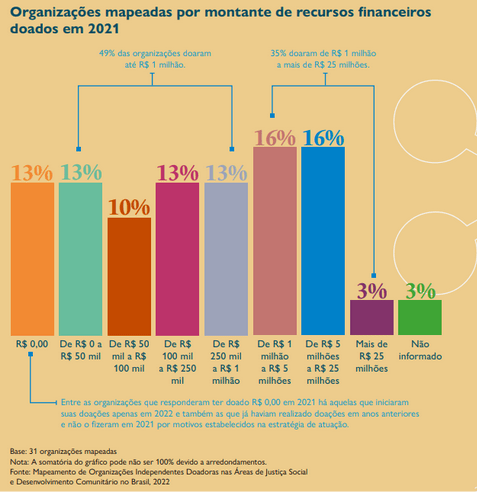
As can be seen in the following graph, 49% of organizations donated up to R$ 1 million and 35% donated from R$ 1 million to more than R$ 25 million. Among the organizations that responded that they did not donate resources in 2021, there are those that only started donating in 2022 and those that had already made donations in previous years and did not do so in 2021 for reasons defined in the operational strategy. The donation budget of the mapped organizations in 2021 shows a lot of variation, which indicates that there is diversity in the donation capacity among the mapped organizations.
_____
(2) GIFE. Project base. Available at: https://mosaico.gife.org.br/base-de-projetos
More information about mapping research
The organizations were mapped using the snowball method and also by searching for organizations on specialized and news websites. The snowball method is a sampling technique that uses reference networks and indications, used when the research universe is not defined. The results presented are not exhaustive and do not represent the entire field, as there is no consolidation of all organizations operating in Brazil that meet the criteria.
Even though there are limitations, the 31 organizations mapped are the result of an effort to reach as many indications and territorial diversity as possible. Of the 31 organizations, 16 are part of the Comuá Network and 15 have been mapped. Below is the complete list of all organizations participating in the research:
Comuá Network Organizations
Baobá – Fund for Racial Equity
Casa Fluminense
ELAS+ Donate to Transform
Brazil Human Rights Fund Foundation
Brazilian Environmental Education Fund (FunBEA)
Casa Socioambiental Fund
Positive Background
Climate and Society Institute (iCS)
Baixada Maranhense Community Institute
Greater Florianópolis Community Institute (ICOM)
Procomum Institute
Population and Nature Society Institute (ISPN)
Maré Networks
Taboa Community Strengthening
Mapped organizations
Association of Remaining Quilombo Communities of the Municipality of Oriximiná (ARQMO) – Quilombola Fund
Association of Black Audiovisual Professionals (APAN) – Support Fund for Black Audiovisual Professionals (FAPAN)
Endowment Semper FEA Association
Nossa Cidade Association – Brumadinho Regenerative Fund
BrazilFoundation (3)
Ecumenical Service Coordination (CESE)
Federation of Foundations and Associations of Espírito Santo (Fundaes)
Federation of Indigenous Organizations of Rio Negro (FOIRN) – Indigenous Fund of Rio Negro (FIRN)
Federation of Bodies for Social and Educational Assistance (FASE) – Saap Fund
Agbara Fund (4)
Dema Fund – Federation of Bodies for Social and Educational Assistance (FASE)
Iratapuru Fund
Sustainable Juruti Institute (IJUS) – Sustainable JURUTI Fund (FUNJUS)
Manauara Community Association
Interstate Movement of Babaçu Coconut Breakers (MIQCB) – Babaçu Fund
PODÁALI – Indigenous Fund of the Brazilian Amazon
Silo – Art and Rural Latitude
_____
(3) The organization was not a member of Rede Comuá during the period in which the mapping was carried out.
(4) The organization was not a member of Rede Comuá during the period in which the mapping was carried out.
Check out the publication KeyFacts of the mapping available at Portuguese is at English.
About the Comuá Network: Rede Comuá is a space that brings together community funds and foundations, donor organizations (grantmakers) that mobilize resources from diverse sources to support groups, collectives, movements and civil society organizations that work in the fields of social justice, human rights, citizenship and development community.
About the bridgeAponte: pontAponte is a consultancy created in 2011 with a focus on qualifying social investment and philanthropy, expanding its positive impact. The company develops research, mapping and content production processes about the field, as well as call processes (announcements, awards and challenges), empowerment of civil society organizations, monitoring and evaluation and development or qualification of a social investment strategy.